

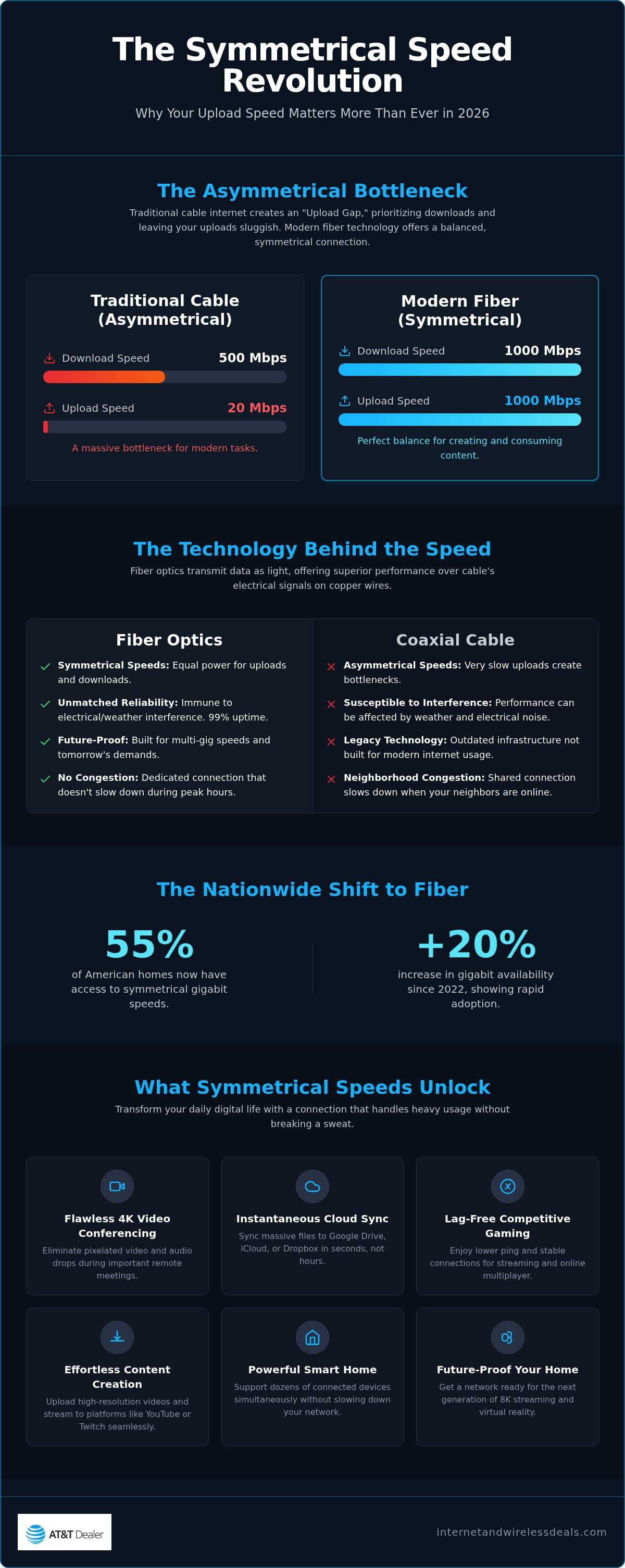
Did you know that 55% of American homes now have access to symmetrical gigabit speeds? That is a massive 20% increase since 2022. You probably feel the frustration every time a 4K video takes hours to post or your Zoom call turns into a pixelated mess. It's exhausting to wait on a connection that only works one way. You deserve a network that keeps up with your high-speed lifestyle. Symmetrical upload download speeds are no longer a luxury; they are the standard for any serious power user in 2026.
Stop settling for a connection that bottlenecks your productivity and kills your gaming win-streak. We promise to show you exactly how equal speeds eliminate lag and transform your home office into a professional powerhouse. This guide previews the latest multi-gig technology and explains how to get a future-proof connection today. Discover how symmetrical upload download speeds provide the raw power you need for instantaneous sharing and crystal-clear communication. It's time to upgrade to the peak performance your hardware was built for.
Key Takeaways
- Master the technical difference between fiber and cable to ensure your network isn't held back by outdated coaxial bottlenecks.
- Discover how symmetrical upload download speeds transform your remote work experience with crystal-clear 4K conferencing and zero lag.
- Identify the perfect speed tier for your household, ranging from essential 300 Mbps plans to elite 5 Gig multi-gigabit connections.
- Eliminate data anxiety and connection drops with 99% reliable fiber technology designed for heavy content creation and gaming.
- Future-proof your digital life with a network that handles massive cloud backups and smart device data simultaneously.
What Are Symmetrical Upload and Download Speeds?
Imagine an internet connection where you never have to wait. That is the reality of symmetrical upload download speeds. In the past, internet providers focused almost entirely on download speeds. They assumed you only wanted to consume content. That old model is broken. Symmetrical speeds mean your upload and download rates are identical. If you have 1000 Mbps for downloading, you have 1000 Mbps for uploading. It is total balance for your digital life. This is the defining feature of elite fiber networks.
Traditional cable providers still rely on an outdated "asymmetrical" model. They might offer you 500 Mbps down but only a measly 20 Mbps up. This creates a massive bottleneck known as the "Upload Gap." In 2026, this gap is the primary reason for digital frustration. You can't run a modern high-performance home on a one-way street. Your devices are constantly sending data back to the web. When your upload speed is a fraction of your download speed, your entire network feels sluggish and unresponsive.
Download vs. Upload: A Quick Refresher
Think of downloading as pulling data from the web. It's what you do when you stream a movie or open an email. Uploading is the act of pushing data back out. It's the engine behind your professional life. Every Zoom call, cloud backup, and social media post relies on your upload capacity. Most users don't notice their upload speed until it fails them. When your video freezes during a presentation or a 10GB file takes hours to send, you've hit the limit of an asymmetrical connection. While a Symmetric digital subscriber line offered a glimpse into this technology years ago, modern fiber has perfected it for the mass market.
The Symmetrical Advantage in a Nutshell
Upgrade to a connection that works as hard as you do. Symmetrical speeds provide instantaneous cloud syncing for platforms like Google Drive and iCloud. You can finally say goodbye to the dreaded buffering wheel when sending large email attachments. It's about efficiency and professional reliability. Symmetrical speed is the two-way street of the digital world where data moves with equal power in both directions. With AT&T Fiber, you get this peak performance across all tiers, from 300 Mbps up to 5 Gigs. There are no data caps to slow you down. You get 99% reliability to keep your home office running at full throttle. Stop settling for half a connection and start experiencing the full power of fiber.
The Tech Behind the Speed: Fiber vs. Cable Networks
Fiber-optic technology is the undisputed gold standard of 2026. It uses pulses of light sent through glass strands thinner than a human hair to transmit data. This allows information to travel at incredible velocities in both directions simultaneously. Cable internet relies on coaxial copper wires that carry electrical signals. These signals are far more limited by physical constraints. Because fiber doesn't have to share its "lane" between incoming and outgoing data, it effortlessly maintains symmetrical upload download speeds.
Cable internet is a legacy system. It was originally built for television broadcasting. In that old model, data only flowed one way: into your living room. When the internet arrived, engineers had to squeeze two-way data into a one-way pipe. They chose to prioritize download bandwidth because that's what early web users needed. This design "cheat" leaves your upload speed in the dust. You might get 500 Mbps down, but your upload is stuck at a tiny fraction of that. The FCC's Thirteenth Measuring Fixed Broadband Report highlights how infrastructure impacts real-world performance. Cable is prone to neighborhood congestion. If everyone on your block is streaming, your speeds drop. Fiber doesn't have this problem.
Why Cable Internet is Asymmetrical
Cable providers are physically limited by frequency allocation. They dedicate the vast majority of the available spectrum to download channels. This leaves a tiny sliver for everything you send out. It's like trying to merge a ten-lane highway into a single-lane side road. Weather and electrical interference also plague copper wires. Fiber is immune to these issues. It doesn't corrode or suffer from electromagnetic noise. This extreme reliability is why 2026 home builders are ditching cable entirely in favor of fiber-to-the-home installations.
Fiber: The Future-Proof Solution
Fiber is built for the long haul. Its signal doesn't degrade over distance like copper does. You get the same blistering speed whether you are next to the hub or miles away. If you're tired of the lag, upgrading from cable to fiber internet is the single best move you can make. It solves the upload crisis instantly. You can scale your connection from 300 Mbps to 5 Gigs without needing a technician to swap your lines. Experience the difference of a professional-grade network today. You can check your address for AT&T Fiber availability to see if you can unlock these speeds in your neighborhood.
Real-World Benefits: Why Symmetrical Speeds Change Everything
Stop waiting for your technology to catch up with your ambition. In 2026, your internet connection is a two-way street. If you work from home, you know the pain of a "connection is unstable" warning during a high-stakes presentation. Symmetrical upload download speeds eliminate this professional embarrassment. You get crystal-clear 4K video conferencing because your outgoing signal is just as strong as your incoming one. It is the difference between looking like a pro and looking like a glitchy avatar. Your network finally has the muscle to handle your workload without breaking a sweat.
Content creators see the most dramatic transformation. On a legacy cable connection, a 10GB 4K video file can take hours to upload. With AT&T Fiber, that same file flies to YouTube or TikTok in just minutes. This massive time savings lets you focus on creating rather than watching a progress bar. Real-time cloud backups for your photos and documents happen instantly in the background. You never have to worry about losing data because your system protects everything as it happens. The FCC broadband report confirms that fiber is the only technology consistently delivering this level of two-way performance.
The Gamer's Edge: Low Latency and High Upload
Winning requires more than just skill. It requires a connection that reacts as fast as you do. Symmetrical fiber reduces "ping" and "jitter" to nearly non-existent levels. This gives you a split-second advantage in competitive shooters and racing games. If you stream on Twitch or YouTube, you can broadcast in high definition while playing at peak settings. You won't drop frames or lag out because your upload bandwidth is dedicated to your stream. Asking how fast is fiber internet is the first step toward building a pro-grade gaming setup. With wired speeds maxing out at 4.7Gbps on 5 Gig plans, you have more than enough power for any lobby.
Large Households and Multiple Devices
Modern homes are data hungry. Research shows that at least 48% of American homes now have at least one smart device, and many have dozens. Your security cameras, smart locks, and thermostats are constantly pushing data to the cloud. In a large household, five people on five different devices can easily crush a traditional cable connection. Symmetrical bandwidth prevents the "bandwidth hog" effect. One person can start a massive cloud backup without causing another person's movie to buffer. AT&T Fiber offers 99% reliability and no data caps. This ensures your 2026 smart home ecosystem stays connected and responsive at all times.
Determining Your Speed Needs: Is Symmetrical Internet Necessary for You?
Not every household requires a 5 Gig connection, but everyone deserves a balanced network. You need to identify your specific digital footprint to choose the right tier. Symmetrical upload download speeds are the foundation of a frustration-free home. If you are a casual user who only browses and watches Netflix, you might think asymmetrical cable is enough. However, the moment you upload a photo gallery or join a video call, that cable connection will struggle. Even basic digital life is more responsive when your upload isn't an afterthought.
For the Home Office Pro, anything less than symmetrical is a professional risk. You can't afford to have your connection drop during a client pitch. A high-performance fiber line ensures your video remains crystal clear while you share your screen. Creative studios and content creators face an even greater need. Handling RAW image files or massive video projects requires the raw power of a fiber-to-the-home connection. If you are a smart home enthusiast with 20 or more connected devices, your network is constantly pushing data to the cloud. Security cameras and smart hubs require constant outgoing bandwidth to function correctly. Without symmetrical bandwidth, your devices will compete for a tiny sliver of upload capacity.
The 'Upload Test' for Your Home
Recognizing "Upload Starvation" is the first step toward a better experience. Are your cloud backups taking all night? Does your gaming ping spike when someone else starts a video call? These are signs that your network is unbalanced. Check your current bill for the 'hidden' upload speed figure to see the massive gap in your service. Most cable customers are shocked to find they have less than 10% of their download speed available for uploading. If your test results show a massive disparity, your hardware is being throttled by your provider's outdated infrastructure.
Cost vs. Performance: The Value Equation
Fiber provides superior value because it delivers the full speed you pay for in both directions. Premium cable plans often charge more for "speed" that only applies to downloads. You can find incredible value by looking at AT&T fiber internet deals designed for 2026 power users. Investing in fiber means you won't need constant hardware upgrades as your data needs grow. It is a long-term solution for a modern home. If you are ready to stop settling for half a connection, find the perfect AT&T Fiber plan for your home and experience true digital balance.
Experience the AT&T Fiber Advantage: Symmetrical Speeds Up to 5 Gigs
AT&T Fiber stands alone as the definitive gold standard for home connectivity in 2026. It's the only choice for users who refuse to settle for second-best. While cable providers struggle with legacy copper wires, AT&T uses 100% fiber-optic technology to deliver a superior user experience. This means you get symmetrical upload download speeds on every plan. Whether you're a small family or a professional content studio, there's a tier designed for your specific lifestyle. It's time to stop compromising and start optimizing your home network for peak performance. You deserve a connection that works as hard as you do.
Choose the speed that matches your digital ambition. The Internet 300 plan offers a rock-solid foundation for everyday browsing and high-definition streaming. Serious professionals can step up to the Internet 500 or 1 Gig plans to handle massive multi-device environments without a single lag spike. For those who demand the absolute peak of modern technology, the 5 Gig plan delivers wired speeds up to 4.7 Gbps. This is raw, unfiltered power for your home office and gaming rig. You get 99% reliability and zero data caps. You have the total freedom to upload, stream, and backup your entire digital life without ever hitting a wall or paying overage fees.
Why AT&T Fiber Wins in 2026
Professional-grade success in 2026 requires professional-grade tools. AT&T Fiber provides industry-leading hardware and the latest Wi-Fi standards to ensure your signal reaches every corner of your home with maximum strength. You get transparent pricing and award-winning customer service that treats your connectivity as a top priority. This is a results-first brand dedicated to keeping you connected at the highest possible speeds. Check the fiber internet availability map to see if your specific neighborhood is eligible for this massive technological upgrade today. Don't wait for the future to arrive when you can plug into it right now.
Lock in Your New Customer Deal
Switching from outdated cable to elite fiber has never been more rewarding. AT&T offers exclusive, high-value promotions for new customers looking to escape the frustrating limitations of asymmetrical internet. The installation process is simple, fast, and handled by expert technicians who value your time. You can move from sluggish coaxial wires to cutting-edge light pulses in a single visit. Stop letting your current provider hold you back with slow uploads and unreliable service. Take command of your digital future and join the millions of power users who've already made the switch. Check AT&T Fiber Availability and Claim Your Deal Today!
Unlock the Peak Performance of 2026
You now have the definitive blueprint for a superior home network. The era of settling for sluggish cable uploads is officially over. Fiber-optic technology is the only infrastructure capable of delivering true symmetrical upload download speeds at a massive scale. By choosing a balanced connection, you're investing in crystal-clear communication and instantaneous data sharing. You've learned how AT&T Fiber provides 99% reliability and blistering speeds up to 5Gbps. This isn't just an upgrade; it's a complete digital transformation for your entire household.
Take control of your connectivity right now. AT&T is ranked #1 in Customer Satisfaction for Fiber because it delivers on its promise of peak dependability. Stop waiting for progress bars and start experiencing the freedom of a network with no data caps and no limits. Switch to AT&T Fiber for Symmetrical Speeds Today! and join the ranks of elite power users who demand the best hardware available. Your future-proof home office is just one click away. You deserve a network that moves as fast as your ideas.
Frequently Asked Questions
What is the difference between symmetrical and asymmetrical internet?
Symmetrical internet provides equal power for both sending and receiving data. If your plan is 1 Gig, you get 1,000 Mbps for both downloading and uploading. Asymmetrical internet, common with cable providers, offers high download speeds but severely limited upload capacity. This imbalance causes major lag when you try to share large files or host professional video calls from your home.
Is symmetrical internet better for online gaming?
Absolutely. Symmetrical speeds are the secret weapon for competitive gamers in 2026. While download speed handles the game data coming in, your upload speed sends your actions to the server. Equal speeds ensure your "ping" remains low and stable. This prevents frustrating lag spikes and ensures your inputs register instantly during intense matches. It's the only way to play at a professional level.
Do I need special equipment for symmetrical speeds?
You need a fiber-optic ONT and a high-performance router to handle these speeds. Standard cable modems cannot process symmetrical data. AT&T Fiber provides industry-leading hardware, including Wi-Fi 7 gateways, to ensure your wireless devices can actually reach these blistering speeds. Using older hardware will bottleneck your connection and waste your bandwidth potential. Upgrade your gear to unlock the full power of your network.
Why is my upload speed so much slower than my download speed on cable?
Cable internet was built on legacy television infrastructure. These coaxial copper wires were designed to broadcast data in one direction. To add internet, engineers had to squeeze upload data into a tiny sliver of the available frequency. They prioritize download bandwidth to keep the "one-way" design intact. Fiber-optic technology removes these physical limits entirely, allowing data to flow freely in both directions simultaneously.
Is symmetrical fiber internet more expensive than cable?
Not necessarily. In 2026, fiber plans are often priced competitively with premium cable packages. The real difference is the value. With cable, you pay for a high download speed but receive a uselessly slow upload. Fiber gives you the full speed you pay for in both directions. It eliminates the need for expensive equipment upgrades and provides a more reliable, future-proof connection for your modern home.
Can I get symmetrical speeds with 5G home internet?
Wireless technology like 5G Home Internet or AT&T Internet Air usually remains asymmetrical. While 5G offers impressive download speeds, the upload capacity is limited by signal strength and tower congestion. Fiber-optic lines are the only way to guarantee symmetrical upload download speeds at gigabit levels. For a professional-grade home network, a hardwired fiber connection is still the undisputed champion of performance and reliability.
How do I know if I have symmetrical speeds right now?
Run a digital speed test while connected to your router via an Ethernet cable. Look at the two numbers provided: your download and your upload. If the numbers are nearly identical, you have a symmetrical connection. If your upload is a tiny fraction of your download, you are likely stuck on an outdated cable or DSL network. This imbalance is the primary cause of modern connectivity issues.
What activities require high upload speeds?
Modern life is driven by data sharing. High-resolution video conferencing, uploading 4K video files, and real-time cloud backups all demand high upload capacity. If you have dozens of smart home devices pushing data to the cloud, you need symmetrical upload download speeds to keep everything running smoothly. Without it, your security cameras and smart hubs will constantly compete for a tiny sliver of bandwidth and cause network crashes.


