

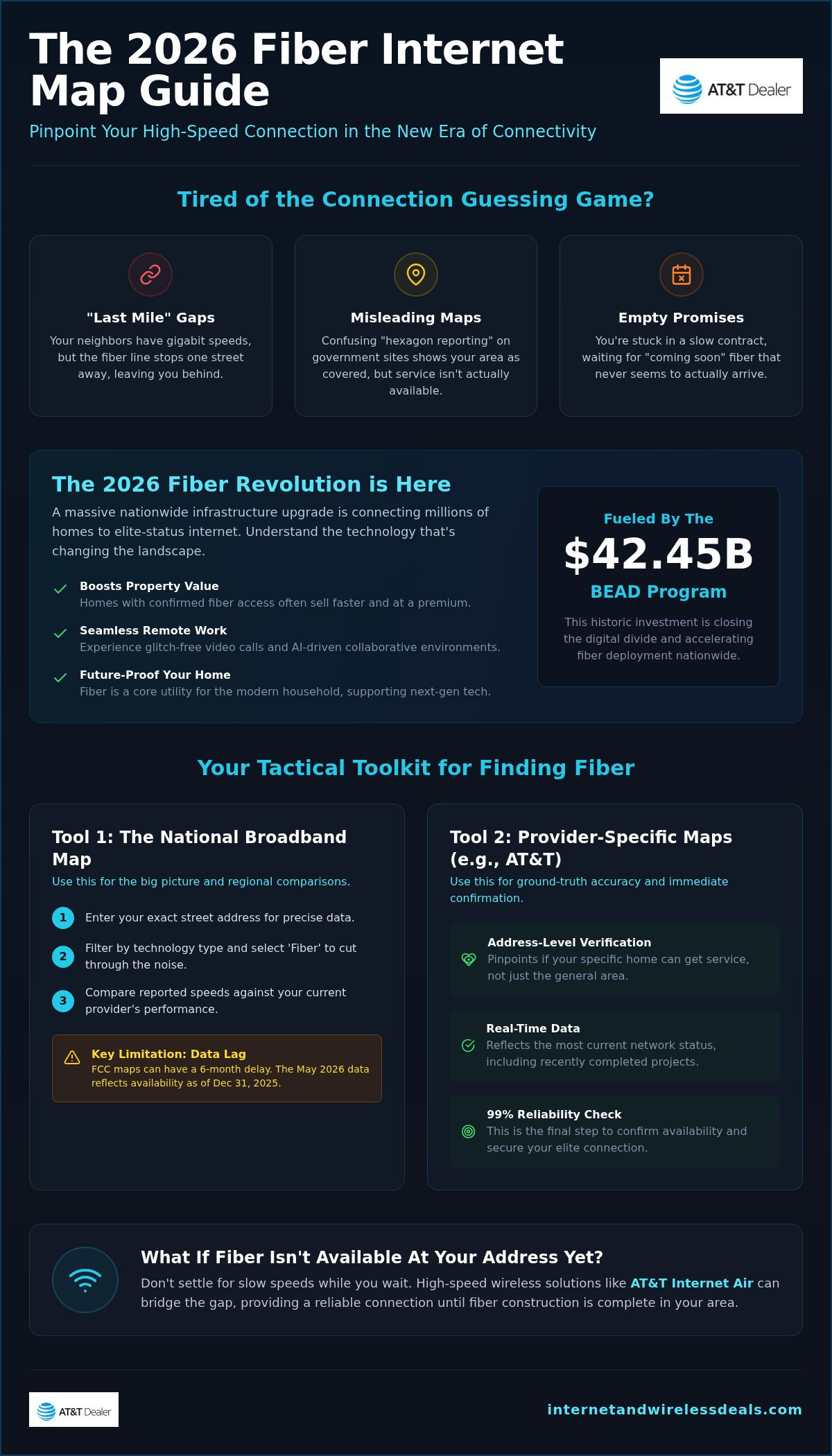
Stop settling for "coming soon" promises that never actually arrive. ⚡ You need a precision fiber internet availability map that reflects the massive 2026 infrastructure surge. We know the struggle. It's maddening to see your block shaded for service on a government site only to find out the physical lines are miles away. You're tired of confusing "hexagon reporting" and outdated data that leaves you stuck with sluggish speeds while your neighbors enjoy gigabit performance. This guide changes the game. We'll show you exactly how to navigate the latest interactive maps and pinpoint when high-speed AT&T Fiber hits your front door. 🚀
Discover the critical differences between broad national maps and hyper-accurate provider tools. The FCC has streamlined data collection this year, but you still need a strategy to find the truth. We'll break down the expansion timelines fueled by the $42.45 billion BEAD program. Get ready to stop searching and start streaming at peak performance. We are providing the definitive roadmap to understand coverage and secure your elite connection immediately. ✅
Key Takeaways
- Master the 2026 fiber internet availability map to identify active service zones and upcoming infrastructure projects in your neighborhood. 🗺️
- Learn the step-by-step process for using the FCC National Broadband Map to verify reported speeds at your exact street address. 📍
- Discover why "hexagon reporting" can be misleading and how to identify the "Last Mile" gaps that might be blocking your connection. 🔍
- Find high-speed alternatives like AT&T Internet Air to bridge the gap if fiber hasn't reached your front door yet. ⚡
- Unlock the secret to securing 99% reliable AT&T Fiber by using direct address-level verification tools for the most accurate results. ✅
Navigating the 2026 Fiber Internet Availability Map Landscape
A fiber internet availability map is your tactical command center for speed. It’s a visual representation of where high-speed glass lines actually live. Think of it as a treasure map where the gold is symmetrical gigabit speeds. 2026 is the definitive milestone year for this technology. Thanks to the $42.45 billion BEAD program, infrastructure is exploding across the country. We are seeing millions of locations move from "unserved" to "elite status" almost overnight. It's a high-stakes race to connect the nation, and you need to know where you stand.
Understanding the tech is the first step. Modern fiber-optic communication uses light to move data, leaving copper cable in the dust. When you look at a map, you'll see two main categories: "lit" and "planned." A lit area is active. You can order service today. A planned zone means the money is there and the crews are coming. Knowing the difference saves you from signing a long-term contract with a slow provider right before fiber arrives on your block. Don't get locked into yesterday's tech when the future is months away.
Fiber isn't just about entertainment. It's a massive property value booster. Homes with confirmed fiber access often sell faster and at a premium. For remote workers, it's the difference between a glitchy video call and a seamless, AI-driven collaborative environment. High-speed access is no longer a luxury; it's a core utility for the modern household. If your address isn't on the fiber internet availability map yet, you're living in the digital past.
Why Real-Time Map Data Matters for Your Home
Stop falling into the "cable trap." Legacy providers often promise "high-speed" that fluctuates during peak hours. A real-time map shows you exactly where those dedicated fiber lines end. You might live in a "fiber desert," which is a specific block or neighborhood skipped by major upgrades despite being in a connected city. Identification is power. Use this data to negotiate. If you show your current provider that fiber is active on the next street over, you gain immediate leverage for better rates or hardware upgrades.
The Difference Between National and Provider-Specific Maps
National maps, like the FCC's official portal, provide the big picture. They show every ISP in the country and are great for comparing regional coverage. However, they often suffer from a six-month data lag. If a crew finished your street last week, the FCC might not know yet. That’s why you need provider-specific maps. Tools from leaders like AT&T offer real-time, address-level readiness. Always check both. Use the national map to see your options, then hit the provider map to confirm you can get connected immediately. Precision is everything when you're hunting for gigabit speeds.
How to Use the National Broadband Map for Your Search
Ready to take control of your connectivity? Start with the source. Visit the official National Broadband Map immediately. This is the federal hub for all 2026 connectivity data. Don't settle for generic neighborhood estimates. Enter your exact street address to see the specific data points tied to your property. This is your first step in mastering the fiber internet availability map landscape. It provides the foundation you need to make an informed decision about your home office or entertainment setup.
Follow these steps for a precision search. First, filter by technology type. Select 'Fiber' to clear the noise of slower cable or DSL options. This instantly reveals which providers claim to have glass lines in your ground. Next, compare the reported speeds against your current plan. If the map shows 1 Gig availability but you're stuck at 100 Mbps, it's time to switch. Finally, look for the 'Challenge' button. If a provider claims they serve your home but you know they don't, report it. Your feedback improves the map for everyone. Accuracy is the key to getting the service you pay for.
Interpreting the 2026 FCC Data Collection Results
The FCC updated its Broadband Data Collection (BDC) program on May 20, 2026. This move streamlined the reporting process to reduce errors and improve transparency. However, keep in mind the data lag. The May 2026 map release reflects provider data as of December 31, 2025. Don't accept the 'Max Advertised Speed' as a guarantee. It's a ceiling, not a floor. Many areas show as 'Served' on the broad map because of legacy technology, but they lack the dedicated fiber lines you actually want. If you want the most current status without the lag, verify your address directly for real-time updates.
Filtering for Gigabit and Multi-Gigabit Tiers
Elite performance requires specific filters. Look for the 1 Gig, 2 Gig, and 5 Gig tiers on the map interface. These represent the gold standard of 2026 connectivity. Pay close attention to upload speeds. Fiber is unique because it offers symmetrical performance. This means your uploads are just as fast as your downloads. This is essential for creators, gamers, and remote professionals who handle massive files. For a deeper look at what these numbers mean for your daily routine, check out our guide on how fast is fiber internet. Secure the speed you deserve today.
Understanding Fiber Coverage: Why Maps Don't Always Tell the Whole Story
Ever wonder why your neighbor is gaming at 5 Gig speeds while you're stuck on a buffering wheel? It's the "Last Mile" problem. Even if a fiber internet availability map shows your block is covered, the physical connection might stop ten feet from your driveway. This happens because high-speed glass lines require specific hardware termination at every single address. Maps give you the big picture, but they don't always account for the physical reality of your property line. Don't assume coverage until you see the tech at your curb. 🚧
Let's talk about "Hexagon Reporting." The official National Broadband Map uses a grid system to show coverage. If a provider serves just one home in a specific hexagon, the entire area can look "green" on the map. This creates a massive gap between what the map says and what you can actually order. Don't be fooled by broad strokes of color. You need to verify the specific serviceability of your front door to avoid the "map says yes, tech says no" frustration. Accuracy is everything in the race for gigabit speeds. 🛑
There is also a major difference between deployment and activation. Laying the cable is only half the battle. After the lines are in the ground, providers must "light up" the network through central office upgrades and software integration. This gap can last weeks or even months. If you see crews working on your street, the map might update to show service is "planned" or "coming soon." This is the time to prepare, but don't cancel your current provider until you have a confirmed installation date. ⚡
The Role of Micro-Trenching and 2026 Infrastructure Tech
Speed is the theme for 2026. Providers are now using micro-trenching to lay fiber faster than ever. This method cuts small, shallow grooves into existing pavement instead of digging massive trenches. It's revolutionizing urban fiber maps, but rural areas still face longer wait times due to complex permitting and geography. Local permit delays can leave a neighborhood "lit" on paper but dark in reality for months. Watch for these infrastructure shifts to predict your activation date with professional precision. 🛠️
Why Address Validation Beats Broad Map Searching
A broad map is a macro view. Address validation is micro accuracy. While a fiber internet availability map helps you understand regional trends, it's not a service guarantee. Before you plan a move or cancel your current service, you must run a direct address check. This is the only way to confirm if the signal is live and ready for your devices. Check out our best AT&T internet plan for me guide to see how to validate your specific location and find the right tier for your needs. Always sign up for "Notify Me" lists to get the jump on new activations the moment they go live. 📈
What to Do if Fiber Isn't Available at Your Address Yet
Don't let a blank spot on the fiber internet availability map stall your digital life. If your address is currently outside the fiber zone, you still have elite options to stay connected. You need high-speed performance now, not "eventually." Modern connectivity isn't just about glass lines; it's about finding the right bridge technology to power your smart home and remote office today. ⚡
Check for AT&T Internet Air immediately. This is the premier 5G home solution designed specifically for areas where fiber hasn't reached the curb yet. You can also explore Fixed Wireless options that provide a robust, dependable signal to bridge the gap. While you wait for the fiber build-out, bundle your wireless service to maximize your savings. For those who value total freedom, look into AT&T no contract internet. It provides the flexibility you need without long-term commitments, ensuring you're ready to switch to fiber the second it goes live. 🚀
AT&T Internet Air: The 5G Alternative
5G home internet is the game-changer for 2026. It uses the same powerful network that fuels your mobile devices but optimizes it for home use. Is 5G enough for your lifestyle? For most households, the answer is a resounding yes. It handles 4K streaming, heavy gaming, and multi-device video conferencing with ease. If the fiber internet availability map shows your neighborhood is still in the "planned" phase, this is your immediate solution. Dive into the technical specs with our AT&T Internet Air guide to see how this hardware stacks up against legacy cable. 📡
How to Speed Up Fiber Expansion in Your Neighborhood
You aren't powerless in the expansion race. ISPs prioritize areas with high demonstrated interest. Organize community petitions and ensure every neighbor registers on the "Notify Me" lists. If your map status is "Planned," it means the engineering is done and construction is the next hurdle. 2026 is also the year of "overbuilding." Providers are aggressively moving into cable-heavy areas to offer a superior alternative. Your collective voice can move your neighborhood up the priority list. Don't wait for progress; demand it. 📈
Ready to see what's possible for your address? Check your real-time availability now and secure the best connection for your home.
Get Connected: AT&T Fiber Availability and Exclusive Deals
AT&T Fiber dominates the fiber internet availability map for a reason. It is the gold standard of 2026 connectivity. You get 99% reliability. You get symmetrical upload and download speeds. This means your data moves at the speed of light in both directions. No more lag. No more dropped calls. Just pure, unadulterated performance. ⚡
The 2026 landscape is competitive, but AT&T remains the top-rated choice. Why? Because the infrastructure is built for the future. Whether you are running a home office or a high-stakes gaming rig, this is the connection you need. Don't just look at a broad fiber internet availability map; join the network that sets the pace for the entire industry. Check out the latest AT&T fiber internet deals and see how much you can save today. 🚀
New Customer Promotions for 2026
Stop waiting for the perfect time to switch. The best time is right now. 2026 brings massive incentives for new sign-ups. We are talking about instant reward cards that put money back in your pocket. We are talking about equipment fee waivers that slash your startup costs. These aren't just minor discounts; they are aggressive invitations to experience the best internet on the market. ✅
Want to maximize your monthly budget? Learn how to bundle AT&T internet and wireless for the ultimate savings. Combining these services simplifies your life and lowers your total bill. It is the smartest move you can make in 2026. Secure your promotional pricing before these limited-time offers disappear. 📈
What to Expect During Your AT&T Fiber Installation
The transition to gigabit life is seamless. Professional technicians handle the heavy lifting. They ensure your gateway is placed for maximum coverage and peak performance. It is a quick, efficient process designed to respect your time. For a full breakdown of the steps, read our AT&T fiber installation process guide. 🛠️
Your "Day One" experience will be transformative. Imagine connecting all your 2026 smart devices to a network that never flinches. From VR headsets to AI assistants, everything runs faster on fiber. This is the performance upgrade you have been waiting for. Use our tool to check your address and lock in your elite connection immediately. Your home deserves the best. 🏆
Claim Your Elite 2026 Connection Now
The race for gigabit speed is moving fast, and you can't afford to be left behind. You've learned how to decode the fiber internet availability map and navigate the massive 2026 expansion landscape. Don't let a legacy connection throttle your potential or interrupt your productivity. It's time to move beyond the broad maps and verify your specific address to secure the peak performance your modern household demands. ⚡
As an Authorized AT&T Retailer, we provide direct access to elite 2026 Symmetrical Gigabit Speeds. Experience the gold standard of connectivity with a 99% Reliability Rating that powers your lifestyle without interruption. Whether you're locking in a high-tier fiber plan or bridging the gap with advanced 5G home solutions, the results will be instantaneous and transformative. Stop settling for less and start winning the speed race today. 📈
Check AT&T Fiber Availability and Claim Your 2026 Deal!
The future is already at your front door. Grab it now and experience the internet as it was meant to be. 🚀
Frequently Asked Questions
How do I find a fiber internet availability map for my specific address?
Visit our address-level check tool immediately for the most accurate results. While a regional fiber internet availability map provides a general overview, you need micro-accuracy for your front door. Enter your street address to see real-time serviceability and current 2026 promotional tiers. This is the fastest way to move from searching to streaming.
Why does the fiber map say it's available, but I can't order it?
You are likely facing a data lag or a "Last Mile" serviceability gap. Maps often reflect neighborhood-level availability but don't account for specific property line hurdles or hardware termination issues. If the map shows green but the tech says no, the physical line might not have reached your specific terminal yet. Use a direct address validation to confirm your home is truly "lit."
When will fiber internet be available in my area if the map is currently blank?
Expansion timelines depend on local infrastructure projects and federal BEAD funding allocations. If your area is blank, sign up for our "Notify Me" list today to stay ahead of the curve. We track 2026 expansion milestones and will alert you the second your neighborhood moves into the "Planned" phase. Don't wait for progress; stay informed and be the first to connect.
Is the FCC National Broadband Map updated for 2026?
Yes, the FCC released its latest update in May 2026 based on data collected through December 2025. It is a powerful tool for seeing regional competition and government-funded projects. However, for the most current status of AT&T Fiber, always use a provider-specific check. This allows you to bypass the government's reporting delay and see what is live today.
What is the difference between 'Fiber-to-the-Home' and 'Fiber-to-the-Node' on a map?
Fiber-to-the-Home (FTTH) means a dedicated glass line runs directly into your house for peak performance. Fiber-to-the-Node (FTTN) uses fiber to a central point but relies on legacy copper for the final stretch. Always prioritize FTTH on your fiber internet availability map for symmetrical gigabit speeds. It is the only way to ensure you get the full power of a 2026 connection.
Can I get fiber internet if my neighbor across the street has it?
Not necessarily, because fiber boundaries are extremely precise. Service often ends at specific street corners, property lines, or even specific utility poles. If your neighbor is connected but you aren't, you might be in a "fiber desert" awaiting the next construction phase. Run a precision address check to see if your side of the street is ready for activation.
Are there any maps that show future fiber construction plans?
Look for "Planned" or "Under Construction" filters on official provider maps to see the future of your neighborhood. These indicators show where infrastructure is currently being laid or funded by 2026 BEAD grants. While construction maps offer hope, only a live address check guarantees you can order service today. Use these tools to plan your next high-speed upgrade with confidence.
How often do ISPs like AT&T update their coverage maps?
AT&T updates its internal database in real-time as new addresses are "lit" and activated. While third-party or government maps might lag by months, our authorized check tool provides the final word on availability. Don't wait for a broad map to refresh its data. Check your address now for the latest 2026 availability and secure your elite connection immediately.


