

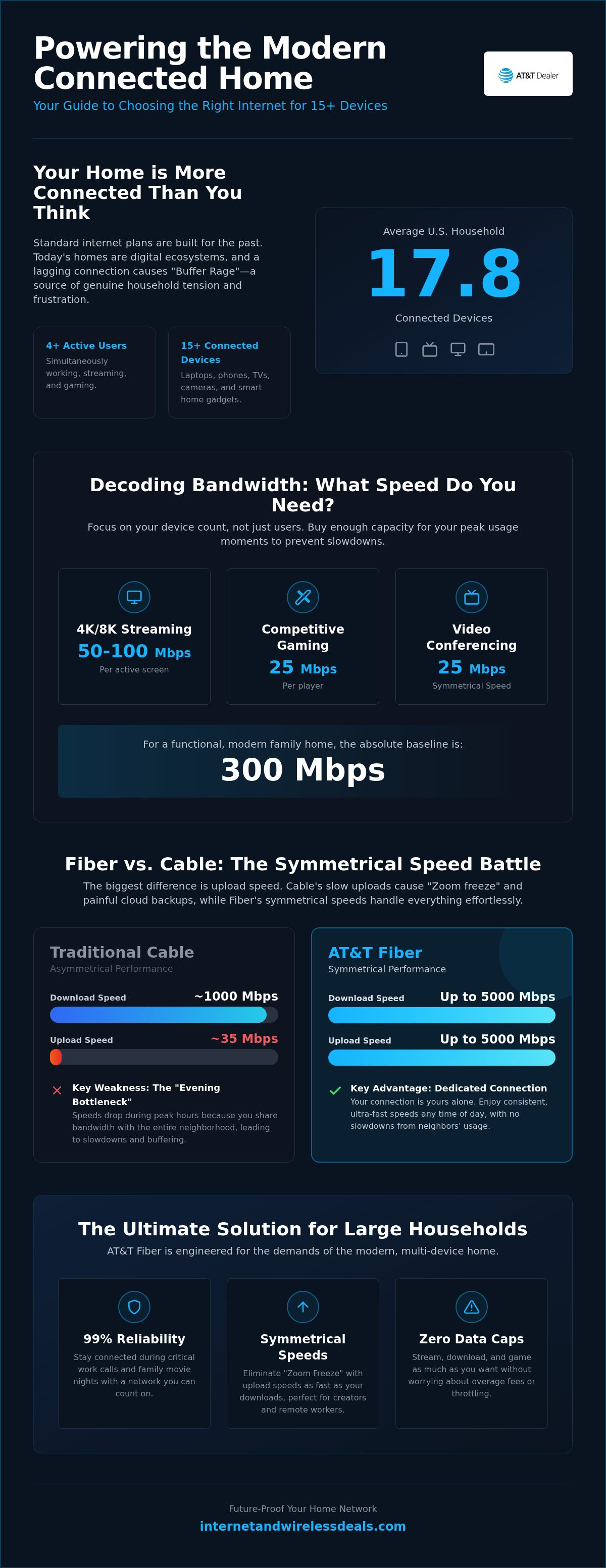
Did you know the average U.S. household now juggles 17.8 connected devices simultaneously? That is a massive digital load for a standard connection to carry. ⚡ Finding the right internet plans for large households is no longer a luxury; it's a necessity for digital survival in 2026.
We understand the frustration. You are mid-presentation on a critical Zoom call while the kids are downloading a massive game update and your partner is streaming 4K content. Suddenly, the spinning wheel of death appears. The "buffer rage" is real, and it's completely avoidable. ✅
Discover the high-speed internet tiers and technology architectures required to power 10+ devices simultaneously without a single second of lag. We will guide you through calculating your household's total bandwidth demand and identifying the premier fiber solutions available today to keep your home running at peak performance.
Key Takeaways
- Upgrade your home network by understanding why 15+ devices demand professional-grade bandwidth. 📱
- Secure the 300 Mbps baseline to eliminate evening bottlenecks for every user in your home. 🚀
- Stop "Zoom freeze" with symmetrical upload speeds that outperform traditional cable every time. 💻
- Select the best internet plans for large households featuring AT&T Fiber's 99% reliability and zero data caps. ✅
Why Standard Internet Plans Fail Large Households
Standard internet packages are built for the past. In 2026, a large household is defined by more than just the number of people under one roof. We are talking about 4 or more active users and a staggering 15 or more connected devices. Your thermostat, your doorbell, and your tablet are all competing for a slice of the digital pie. Generic internet plans for large households fail because they lack the raw capacity to handle this modern density. ⚡
Don't confuse simple speed with total capacity. While speed measures how fast a single packet of data travels, Bandwidth (computing) defines the maximum rate of data transfer across your entire network. Think of it like a highway. A fast car is useless if there is only one lane and twenty other vehicles are trying to use it. You need more lanes to prevent a total standstill during peak hours.
The "Evening Bottleneck" is the ultimate proof of a failing plan. It happens at 7:00 PM. The work laptops are still open, the gaming consoles roar to life, and the 4K streaming starts in the living room. On a standard cable connection, your speeds crater because you are sharing bandwidth with the entire neighborhood. This congestion turns your high-speed dreams into a buffering nightmare. ✅
The Hidden Bandwidth Hogs in Your Home
Your devices are working even when you are asleep. Smart security cameras are the silent killers of your upload speed. They stream high-definition footage to the cloud 24/7, hogging the very bandwidth you need for clear video calls. Automatic OS updates for laptops and massive "Day One" patches for gaming consoles often trigger in the background. Even your smart fridge and speakers pulse with data constantly. This background chatter creates a "floor" of data usage that standard plans simply cannot support.
Buffer Rage: The Emotional Cost of Poor Connectivity
Connectivity issues aren't just technical glitches. They are sources of genuine household tension. A dropped frame during a critical work presentation is a professional disaster. A lag spike during a competitive gaming match causes instant frustration. We call this "Buffer Rage." As we move toward 8K streaming and mainstream VR requirements in 2026, "good enough" internet is no longer an option. It is time to stop settling for a connection that causes stress and start investing in technology that powers your lifestyle without compromise. 🚀
Decoding Bandwidth: How Many Mbps Does Your Family Need?
Stop guessing. Start calculating. In 2026, the entry-level standard has shifted dramatically. A 300 Mbps connection is now the absolute floor for any functional family home. While the FCC's Household Broadband Guide provides a solid starting point, modern families often exceed those basic recommendations within minutes of waking up. You need a network that handles the "everything at once" reality of modern life. 🚀
Your user count is a misleading metric. Focus on your device count instead. Every tablet, smart speaker, and security sensor requires a constant stream of data. When you evaluate internet plans for large households, you are buying capacity for your peak usage moments, not your average ones. This is the Headroom Principle. You want enough extra space so that a sudden system update on a gaming console doesn't crash your professional video call. ✅
Speed Requirements by Activity (2026 Standards)
- 4K/8K Video Streaming: Budget 50-100 Mbps per active screen to ensure crystal-clear quality without the spinning wheel.
- Competitive Gaming: Low latency is the priority, but you still need a dedicated 25 Mbps per player to avoid lag spikes.
- Professional Video Conferencing: High-definition calls require 25 Mbps of symmetrical speed to keep your audio and video perfectly synced.
The Multi-Device Multiplier
Estimating your demand is simple math. Sum up every high-demand activity that happens simultaneously in your home. If two people are streaming 4K movies while another is gaming and you are on a Zoom call, you have already consumed nearly 250 Mbps of your capacity. This does not even account for your background smart home devices or the guest who just hopped on your Wi-Fi. 📱
Think of your bandwidth capacity as the digital "lanes" on your home's information highway. More lanes mean more traffic can flow at top speed without congestion. If you are tired of the digital traffic jam, it is time to upgrade. Before you commit, check if AT&T Fiber is available in your area to secure the massive bandwidth your family deserves. ⚡
Planning for the future means accounting for smart home growth. Every year, the average household adds at least two new connected devices. A plan that works today might be obsolete by next summer. Choose a tier that offers room to grow. This proactive approach ensures your home remains a high-speed sanctuary for work, play, and everything in between.
Fiber vs. Cable: The Battle for Symmetrical Performance
Choosing between fiber vs. cable internet is the most important decision you will make for your home network. Cable internet relies on aging copper wires originally designed for television. This legacy technology creates a massive, frustrating imbalance. You might see fast download speeds on your contract, but your upload speeds are often a tiny fraction of that power. For elite internet plans for large households, this lopsided performance is a complete dealbreaker. ⚡
Symmetrical speeds are the definitive gold standard for 2026. This means you get equal power for both downloading and uploading. When your entire family is active, fiber ensures every single user has a dedicated, high-speed "lane" that never collapses. Cable's weak upload capacity is the primary reason your video freezes during an important work call. It simply cannot handle the outgoing data load when multiple devices are competing for space. ✅
Latency and jitter are the hidden enemies of a smooth experience. Latency is the delay in data transfer. Jitter is the inconsistency of that delay. High-density homes feel these issues instantly through laggy games and choppy audio. Fiber-optic technology uses pulses of light to transmit data, virtually eliminating these performance killers. It provides a rock-solid foundation for professional-grade gaming and seamless communication. 🚀
Why Upload Speed is the Secret to Family Harmony
Upload speed is the silent engine of your modern digital life. You use it every time you send a large work file, engage in cloud gaming, or host a multi-party video conference. A choked upload pipe creates a bottleneck that slows down your entire network. Every device in your home struggles when the outgoing path is blocked. For a comprehensive look at how this impacts you, check out our Fiber Internet Upload Speed: The Complete 2026 Performance Guide. 📱
Reliability Under Pressure
Reliability is essential for critical family needs and remote work. Fiber-optic cables are made of glass, making them immune to electrical interference and far more resistant to extreme weather than traditional cable. You get 99% uptime and consistent performance even during peak hours when the whole neighborhood is online. Stop settling for the cable slowdown. Explore the benefits of upgrading from cable to fiber internet to secure the performance your high-tech home requires. ⚡
Choosing the Right Tier: From 300 Mbps to 5 Gigs
Matching your speed to your lifestyle is the ultimate power move. You don't want to overpay, but you absolutely cannot afford to underperform. Selecting the right internet plans for large households requires a clear-eyed look at your peak usage. ⚡ In 2026, the tiers are defined by capability, not just cost. You need a plan that scales with your ambition and your family's growing device list. ✅
- 300 Mbps: The "Standard Family" tier. This is the 2026 baseline for 3-4 users. It handles consistent 4K streaming and simultaneous social media use without breaking a sweat.
- 500 Mbps: The "Power User" tier. This is built for homes with heavy streamers and digital creators. It provides the extra headroom needed for massive file uploads and constant cloud syncing. 🚀
- 1 Gig (1000 Mbps): The "Pro Household" gold standard. This is the sweet spot for large families. It powers 10+ devices with ease, ensuring total digital freedom for everyone at once.
- 2 Gig to 5 Gig: The "Future-Proof" choice. This is for the ultimate smart home. If you are running 8K streams, VR workstations, and professional-grade servers, this is your only option. ⚡
Is a 1 Gig Plan Worth It for You?
Large families often find themselves at a crossroads. Is the jump to gigabit speed necessary? If you have four or more people trying to stream, game, and work simultaneously, the answer is a resounding yes. You are paying for the peace of mind that your network won't buckle during the 7:00 PM peak. Multi-gig speeds are specifically designed for households with advanced technical needs and dozens of connected IoT devices. To dive deeper into the specifics, read our guide on the 1 Gig Internet Plan: Is Gigabit Speed Right for Your Home in 2026?.
Hardware Matters: Wi-Fi 6 and Wi-Fi 7
Your high-speed plan is only as good as your router. An outdated router acts as a bottleneck, wasting the massive bandwidth you are paying for. ⚡ Upgrade to Wi-Fi 6 or Wi-Fi 7 hardware to unlock the full potential of fiber technology. Use a mesh system to eliminate dead zones and ensure a strong signal reaches every bedroom. For your most critical devices, like gaming consoles and home office PCs, use a wired Ethernet connection to guarantee the lowest possible latency. ✅
Ready to upgrade your digital experience? Find the perfect AT&T Fiber plan for your family today and leave the lag behind for good. 🚀
The Ultimate Solution: AT&T Fiber for Large Households
Stop the search. You have found the definitive answer for your home network. AT&T Fiber stands alone as the premier choice when evaluating internet plans for large households. It is not just about raw speed. It is about a connection with 99% reliability that never blinks when your family needs it most. ✅ This is the high-speed bridge your home deserves. Experience the peace of mind that comes with a network built for the heavy demands of 2026.
Unlimited data is the absolute foundation of a modern, multi-device home. Forget about restrictive data caps. Ignore the fear of overage fees or mid-month throttling. AT&T Fiber offers truly unlimited streaming, gaming, and working for every member of your family. You can power 15 or even 25 devices simultaneously without ever hitting a digital ceiling. ⚡ This is total connectivity freedom, delivered directly to your doorstep with zero compromises.
Professional installation ensures your coverage is optimized from day one. Our experts do not just drop a gateway and leave. They analyze your home layout and test signal strength in every room. This meticulous approach guarantees maximum range and performance for your specific floor plan. Plus, exclusive 2026 deals are available right now. New customer sign-ups often include significant incentives and bundling opportunities with AT&T Wireless Plans. 🚀 Now is the time to optimize your budget and your bandwidth at the same time.
Why AT&T Fiber Wins for Families
Symmetrical gigabit speeds change everything. You get equal power for both downloads and uploads, ensuring your network is never lopsided or congested. This architecture makes AT&T Fiber the best internet for gaming and high-stakes professional remote work. The AT&T Wi-Fi Gateway provides a massive signal reach that penetrates walls and covers multiple floors. Management is effortless with the Smart Home Manager app. You can monitor every connected device, set parental controls, and prioritize bandwidth for critical tasks with a single tap. 📱
Ready to Upgrade Your Home Experience?
Checking availability is your first step toward a lag-free life. Use our national tool to see if your address is Fiber-ready in seconds. The switching process is designed for speed and simplicity. We prioritize minimal downtime so your household stays connected and productive throughout the entire transition. Do not let another day of "buffer rage" ruin your productivity or family entertainment. ⚡ Take control of your home network today with the most advanced technology available.
Check AT&T Fiber availability and claim your 2026 new customer deal!
Claim Your High-Speed Future Today
You now have the definitive blueprint to end the cycle of lag and frustration for good. Settling for a basic connection in 2026 is a choice you no longer have to make. By prioritizing symmetrical performance and selecting the correct speed tier, you ensure every device in your home operates at its peak potential. ✅ Finding the right internet plans for large households is about more than just raw speed; it is about securing a seamless, future-proof lifestyle for your entire family.
We are an AT&T Authorized Retailer dedicated to providing you with the most reliable technology on the market. You get the peace of mind that comes with a 99% Reliability Guarantee and the complete freedom of no annual contracts on fiber plans. ⚡ Stop fighting for bandwidth and start enjoying the digital freedom you deserve. Your household is ready for an upgrade, and we are ready to deliver it with professional precision.
Check AT&T Fiber Availability and Score the Best Household Deals!
Take the first step toward a buffer-free home right now. Your high-speed future is just one click away, and your family will thank you for the upgrade. 🚀
Frequently Asked Questions
How many Mbps do I need for a family of 5?
A family of five needs a minimum of 300 Mbps to 500 Mbps to maintain a smooth experience. This baseline accounts for the average 17.8 connected devices found in modern homes. 🚀 It ensures that simultaneous 4K streaming and video conferencing don't clash. If your household includes competitive gamers or remote creators, moving to the 500 Mbps tier provides the essential headroom required for peak performance during busy hours.
Is 1 Gig internet overkill for a large household?
Gigabit speed is the gold standard for high-density homes, not overkill. In 2026, 1 Gig plans are essential for families juggling 10 or more active devices at once. ✅ It provides the massive bandwidth capacity needed to handle large file downloads while others stream high-bitrate content. You get total digital freedom without worrying about who is doing what on the network. It's the ultimate insurance against "buffer rage."
Does 'Unlimited Data' really mean no slowdowns for my family?
With AT&T Fiber, unlimited data means zero data caps and no speed throttling. You can stream, game, and download as much as you want without facing overage fees or mid-month slowdowns. ⚡ This is a game-changer for internet plans for large households that consume massive amounts of data. Your family gets consistent, top-tier performance from the first day of the month to the last. No compromises. No hidden limits.
What is the best internet for a home with 20+ devices?
Fiber internet is the definitive choice for managing 20 or more connected devices. The symmetrical architecture handles the constant background data from smart home sensors while powering high-bandwidth activities like VR gaming. 📱 AT&T Fiber provides the raw capacity and 99% reliability needed to keep a dense ecosystem of tech running perfectly. It acts as a high-speed bridge between your devices and the latest technology without any congestion.
Why does my internet get slow in the evening even with a fast plan?
Evening slowdowns usually happen because traditional cable networks share bandwidth across your entire neighborhood. When everyone logs on at 7:00 PM, the local "pipe" gets crowded and speeds drop. ✅ Switching to fiber eliminates this problem. Fiber provides a dedicated line to your home that stays fast regardless of what your neighbors are doing. Stop sharing your speed and start enjoying a connection that works on your schedule.
Do I need a special router for a high-speed family internet plan?
You need a Wi-Fi 6 or Wi-Fi 7 compatible router to unlock the full potential of a high-speed plan. An old router acts as a bottleneck, trapping your gigabit speeds inside the wire. ⚡ The AT&T Wi-Fi Gateway is specifically optimized for high-density traffic and wide coverage. It manages dozens of devices simultaneously while ensuring a strong signal reaches every corner of your home. Hardware is just as important as the plan itself.
Can I run 4K streams on multiple TVs at the same time?
You can absolutely run multiple 4K streams simultaneously with a high-capacity fiber plan. Each 4K stream requires roughly 25 to 50 Mbps of dedicated bandwidth. 📺 A 500 Mbps or 1 Gig plan provides more than enough "lanes" to support four or five TVs streaming different movies at once. This ensures crystal-clear picture quality in every room without any spinning wheels or quality drops. It is the perfect setup for large families.
Is fiber internet better than cable for a large household?
Fiber is objectively superior to cable for large households because it offers symmetrical upload and download speeds. Cable networks often have weak upload pipes that cause "Zoom freeze" when multiple people are online. 🚀 Fiber provides the balanced power needed for smooth video calls, cloud gaming, and fast file sharing. It is the most reliable and efficient way to power a modern home with heavy data demands.


