

Fiber on your street doesn’t mean it’s ready at your address. If you’re asking “when will fiber be available in my area,” the answer depends on your exact location, not just what’s happening nearby. A provider’s map may show coverage while its address checker says otherwise, and a construction date may not be available at all.
That uncertainty is frustrating, especially when you need a reliable connection for work, school, or streaming. Fiber rollout depends on factors such as nearby infrastructure, construction plans, local geography, permitting, and expected demand. Crews working nearby don’t necessarily mean your address is ready to order service.
This guide explains what affects rollout timing, why nearby service isn’t a guarantee, and how to check for credible updates without treating an estimate as a promise. You’ll also learn what to do if there’s no published schedule, including how to check AT&T Fiber availability at your address and consider AT&T Internet Air as a possible interim option if it’s available and suits your needs. Here’s how to get a clearer picture and plan your next step.
Key Takeaways
- There’s no universal answer to “when will fiber be available in my area.” Confirm serviceability using your exact address.
- Separate network planning, construction, and service activation when assessing provider updates, and treat estimates as estimates.
- Check provider address tools and follow up with providers or project sources. A ZIP-code result alone doesn’t confirm service at your home.
- While you wait, compare available internet options based on upload needs, reliability, data terms, equipment, and contract flexibility.
- When fiber becomes eligible, review current plan details and installation terms. Check AT&T Fiber availability at your address before considering AT&T options.
When will fiber be available in my area? Start with a realistic timeline
There’s no universal U.S. fiber rollout calendar or guaranteed waiting period. The answer to “when will fiber be available in my area” depends on whether a provider can serve your specific address, not simply whether fiber is nearby. A map may show coverage on your street while your home, building, or individual unit still can’t place an order.
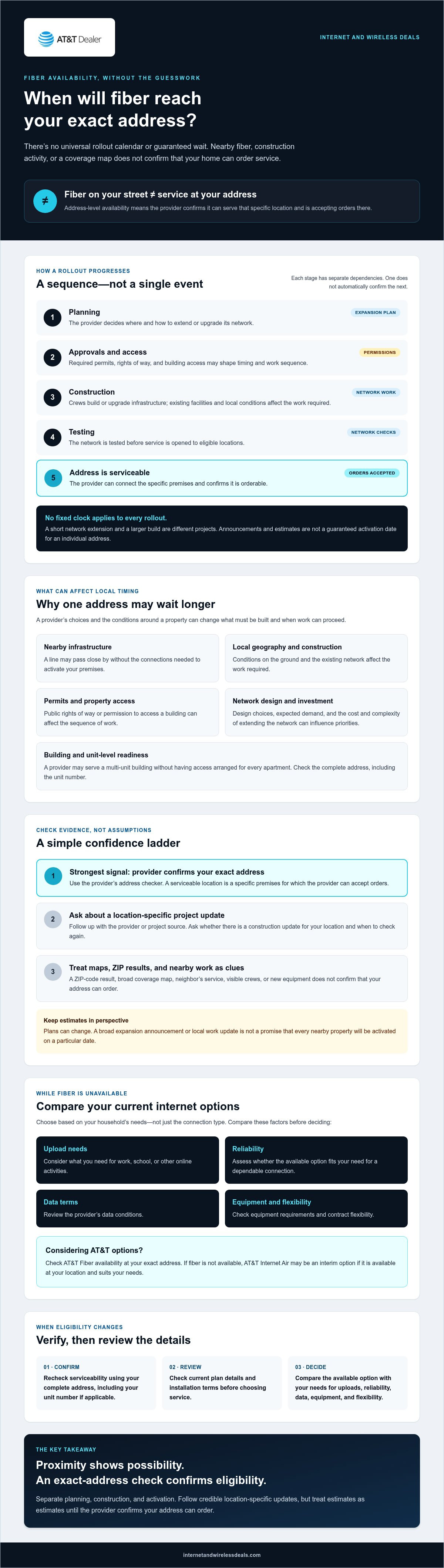
Address-level fiber availability means a provider has confirmed that its network can serve a specific service address and is accepting orders for service there. That’s different from an expansion announcement or visible construction. Think of the process in stages: a provider announces a broad plan, work may begin in a particular area, and only later does a specific address become eligible for orders. There’s no universal schedule for these stages, and one doesn’t automatically confirm the next.
Why nearby fiber does not guarantee service at your address
Network access can change across a street, property boundary, or building. A fiber line may pass nearby without the provider having the connections or infrastructure needed to activate service at your home. Deployment approach matters too. Fiber network architectures can bring fiber to different points in a network, so seeing fiber equipment doesn’t prove that fiber reaches your premises.
Multi-unit buildings add another layer. A provider may serve the building but not have access arranged for every apartment or unit. Check eligibility using the complete service address, including the unit number, rather than relying on a neighbor’s service status.
What a rollout announcement can, and cannot, tell you
A company may announce plans to expand across a broad area without confirming construction on your street. Even a local project update may describe planned work, not a date when every nearby address can order service. Permitting, construction conditions, network design, and provider investment can all affect what happens next.
Visible crews or newly installed equipment are signs of activity, not proof of activation. Plans can change, and a general announcement shouldn’t be treated as a commitment for a particular property. Look for current provider confirmation that your exact address is eligible. If the provider can’t confirm it, ask whether there’s a specific construction update for your location and when to check again. An address check is a stronger signal than proximity, a broad coverage map, or a headline about future expansion.
What determines when fiber internet reaches a specific address?
A fiber rollout isn’t one event. It moves through planning, approvals, construction, testing, and service activation. Each stage has its own dependencies, so a provider can announce an expansion well before a specific home is ready to order service.
From network planning to an orderable fiber connection
Providers first decide where and how to extend their network. They then secure required approvals and access, build or upgrade infrastructure, and test the network before opening service to eligible addresses. A serviceable location is a specific premises the provider can connect and accept orders for. It’s not the same as a general coverage area, which may include nearby places that aren’t yet orderable.
That distinction matters when you’re assessing a rollout. A project can be planned or underway without every address in its announced footprint being ready at the same time. Network design also affects what must be built: existing infrastructure may be close to some properties but not others. Provider investment decisions, expected demand, and the cost and complexity of extending the network can influence which areas are prioritized.
Why construction schedules vary from place to place
Permitting and access can affect the sequence of work. Crews may need permission to use public rights of way or access a building, while local construction conditions and existing infrastructure can shape the work required. A short extension to an existing network and a larger build are different projects. There’s no reliable universal duration to apply to both.
Public funding can support broadband expansion, especially in underserved areas, but it doesn’t set a guaranteed activation date for an individual address. The benefits and costs of broadband expansion help explain why governments support infrastructure investment, while local outcomes still depend on project execution. As of September 2026, all 56 state and territory plans under the federal Broadband Equity, Access, and Deployment (BEAD) Program had been approved, and states were beginning to award construction contracts. The program’s overall deployment goal doesn’t tell you when a particular property will become serviceable.
Use Federal Communications Commission (FCC) and National Telecommunications and Information Administration (NTIA) resources for their specific purposes. They can help you understand reported availability or public broadband programs, but they shouldn’t be read as a provider’s construction commitment for your address. For an actionable check, confirm eligibility directly with the provider. If you’re checking AT&T Fiber, review address-specific AT&T availability through Internet and Wireless Deals, an independent authorized retailer. Treat the result as current eligibility, not a future rollout guarantee.
How to check a fiber rollout timeline without relying on guesswork
Use a consistent process to separate confirmed service from nearby coverage and unverified plans. An address checker answers whether you may be able to order now. Project updates may offer clues about future work, but they don’t replace confirmation from the provider.
Use address checks, maps, and provider support together
Work through these steps in order. Keep a simple record so you can compare results if a tool or provider gives you a different answer later.
1. Check the exact service address. Enter the full address, including any apartment or unit number, into the provider’s current availability tool. A ZIP-code search can help you find providers to investigate, but it doesn’t establish that a particular residence can order fiber.
2. Compare with a public map. Check the FCC National Broadband Map for reported service information, then treat it as a reference point rather than a live construction schedule. The map may not reflect the newest changes, so a listed provider or nearby coverage area isn’t proof of current address-level availability. For help interpreting coverage maps, see this fiber availability map guide.
3. Confirm directly with the provider. Ask whether your exact address is orderable now or simply near existing coverage. If the results conflict, explain what each tool showed and ask the provider to clarify the status for that service address.
Track the details after each check: provider, date, result, and any reference number or case identifier you’re given. Note whether the answer confirms orderability, reports nearby coverage, or provides no definite answer. This makes follow-up clearer and helps you spot meaningful changes rather than relying on memory.
Questions to ask when no launch date is published
If there’s no schedule, ask focused questions: “Is there an active construction or expansion plan for this specific address?” “How can I follow project updates?” “Can you notify interested households if the address becomes eligible?” A provider may not have a date to share, and that’s useful to know. Don’t treat a broad estimate as a commitment unless the provider confirms it for your address.
For AT&T Fiber, use an address-specific availability check to confirm current eligibility. Internet and Wireless Deals, an independent authorized retailer, provides an online pathway to check AT&T availability. A current result can establish whether you can explore service now, but it doesn’t predict a future rollout date where fiber isn’t yet available.
What to do while fiber is not available at your address
If you’re still asking “when will fiber be available in my area,” you don’t have to wait without a plan. Compare the services you can order at your exact address, then choose based on how your household uses the connection. Use the table as a checklist, not a guarantee of performance. Availability and terms vary by provider and location.
| Option | What to verify before choosing |
|---|---|
| Cable | Confirm address eligibility, upload speeds for video calls and file sharing, performance during busy periods, data terms, required equipment, and contract flexibility. |
| Fixed wireless | Check whether service reaches your address, how network conditions may affect performance, upload needs, data terms, equipment requirements, and contract terms. |
| 5G home internet | Confirm address-level eligibility and review current speed information, upload performance, data terms, equipment, and any contract conditions. Ask how performance may vary with local network conditions. |
| DSL | Verify that service is still offered at your address. Compare available upload and download speeds with your household’s needs, and check data terms, equipment, and contract flexibility. |
Match an interim connection to your household’s needs
Start with what you do online. Video calls and sending large files can make upload performance important. Streaming and gaming depend on a stable connection, while several people online at once can increase household demand. Compare the provider’s current details with your actual use rather than assuming a technology label guarantees a particular experience.
Performance can depend on the specific service, network conditions, and setup inside your home. Before signing up, review current terms for data limits or policies, equipment requirements, contract length, and what happens if you cancel. Confirm availability at the service address, not just by ZIP code.
Consider AT&T Internet Air only after checking eligibility
AT&T Internet Air may be an interim fixed-wireless option, but it isn’t a guaranteed substitute for fiber or necessarily available at every address. Check current eligibility and review the plan details and terms before deciding. For more background, read this AT&T Internet Air guide.
Ready to check a listed AT&T option? Check AT&T Internet Air availability for your address through Internet and Wireless Deals, an independent authorized retailer.
How to act when fiber becomes available, and check AT&T options
Seeing fiber listed near your home is a reason to verify, not a reason to rush. Before switching, confirm your exact address is eligible and review what service would involve. Compare a newly available connection with your current internet on practical terms, not just a headline speed.
Recheck serviceability before making a decision
Use a current provider channel to confirm the full service address and the plans actually available there. Then work through this checklist:
- Confirm eligibility: Make sure the result applies to your home or unit, not only the building or nearby area.
- Compare performance: Match the available speeds to your household’s needs, and pay attention to upload performance for video calls, gaming, or sending large files.
- Check installation details: Ask whether technicians need access to your property or building, and whether landlord approval or coordination with household members may be needed.
- Review equipment and terms: Confirm what equipment is required and read the current contract, cancellation, and other plan terms.
- Compare with your current connection: Consider its actual performance and terms alongside the fiber option before deciding whether to switch.
Don’t assume that a map update or a neighbor’s new service confirms your eligibility. Address-level confirmation is the useful signal. If the provider’s answer is unclear, ask what the result means for your specific service address before making plans.
Make the next step simple and transparent
If AT&T Fiber is available at your address, check current eligibility and plan details before choosing. The AT&T Fiber deals guide offers more information to help you review available options. Confirm current terms and installation details through a provider channel, since availability and displayed offers can change.
Internet and Wireless Deals is an independent authorized AT&T retailer, not AT&T itself. If you’d like to explore AT&T options, you can check current AT&T availability and options through the site. It’s an optional next step, not a promise of service, a particular offer, or an activation date.
Take the next step toward a better connection
There’s no universal answer to “when will fiber be available in my area.” Rollout timing depends on the network, construction, and whether a provider confirms your exact address is ready to order. Nearby coverage or a broad expansion announcement isn’t the same as confirmed service.
While you wait, check provider updates and choose an interim connection based on your household’s needs and the current terms. If fiber becomes available, compare upload performance, installation requirements, equipment, and contract details before switching.
Internet and Wireless Deals is an independent authorized AT&T retailer, not AT&T itself. It provides U.S. customers with an online pathway to check availability and explore sign-up options. Availability tools and displayed options can change, so confirm the current details for your address.
Check current AT&T internet availability and explore your options. With a clear address check and a practical backup plan, you can make your next connection decision with confidence.
Frequently Asked Questions
How do I find out when fiber will be available at my address?
Check the full service address with each provider’s current availability tool, then contact the provider to ask whether fiber is orderable or planned for that specific location. A map or ZIP-code search can help identify providers to check, but it may not confirm service at your home. Keep a note of the provider, check date, result, and any reference number so you can follow up and compare future updates.
Can an internet provider tell me when fiber will reach my neighborhood?
Sometimes, but the provider may only be able to confirm a broad expansion plan or construction activity, not a date for your address. Ask whether there’s an active project for your specific location, what stage it’s in, and how updates are shared. Treat a general estimate as unconfirmed unless the provider gives current, address-specific information. Even a neighborhood construction update doesn’t necessarily mean every home can order service.
Does fiber being available nearby mean my home can get it?
No. Fiber on a nearby street or serving another unit in your building doesn’t confirm that your address is serviceable. Network access can vary across property boundaries, and a building may not have connections arranged for every apartment. Check using your full address, including the unit number if applicable. If a neighbor has service but your checker says otherwise, contact the provider and ask it to verify your specific premises.
How often should I check fiber internet availability?
There’s no required checking schedule. As a practical routine, set a reminder to check the provider’s address tool about once a month, and check again after a credible update about construction or network expansion. Keep the results dated so you can see whether eligibility has changed. Don’t read a map update or a new announcement as proof that your home can order service until the provider confirms your exact address.
What happens if my address is not eligible for fiber yet?
If your address isn’t eligible, you’ll need to use an available connection while monitoring for changes. Check which options providers can actually serve at your location, then compare upload performance, reliability, data terms, equipment, and contract conditions against your household’s needs. Fixed wireless, 5G home internet, cable, or DSL may be worth investigating where offered. Recheck fiber availability periodically, but don’t assume a future rollout date.
Can I request that an internet provider bring fiber to my area?
You can contact the provider and ask whether it accepts requests or expressions of interest for expansion. Share your service address and ask if there’s a process for registering household interest. The provider may use demand information as one factor in its planning, but a request doesn’t guarantee construction or establish a timeline. If there’s a public broadband project, check with the responsible agency for updates on its scope and progress.
Is AT&T Fiber available at every address in its coverage areas?
No. Being within a general AT&T Fiber coverage area doesn’t mean every home or apartment can order service. Eligibility is determined for the specific service address and can differ between nearby properties or units. Use a current AT&T availability-check channel with your complete address, then confirm the result and current plan details before deciding.


