

What if a quick phone check before takeoff could help prevent an unexpected roaming charge? AT&T International Day Pass features may make it easier to stay connected abroad, but the details matter: what calls, texts, and data are covered, and what activity starts a daily charge?
It’s reasonable to want your phone to work without surprises. Pass rules can vary by destination, plan eligibility, and whether you’re traveling on land or at sea. Even a brief connection can affect your bill, so check the terms before you go.
This guide explains how the pass works, what usage can trigger a charge, and how billing differs for land travel and eligible cruise ships. You’ll learn what to verify about destinations, plan eligibility, and possible exceptions, including whether your domestic plan already covers part of your itinerary. Use those details to compare the pass with other connectivity options and choose an approach that fits your trip.
Key Takeaways
- Check the pass details that apply to your plan, account, and itinerary before traveling.
- Understand how first use, multiple lines, and billing-cycle limits may affect charges before enabling roaming.
- Compare cellular roaming with Wi-Fi, a SIM, or an eSIM based on coverage, setup, and whether you need your usual number.
- Before departure, confirm account eligibility, destination support, and enrollment, then review your phone’s roaming settings.
- Compare your expected trip length and usage with the pass rules to decide whether its convenience suits your needs.
What AT&T International Day Pass includes for travelers
AT&T International Day Pass is a roaming feature for eligible AT&T wireless accounts. It lets travelers use talk, text, and data in covered destinations under the pass’s terms. It’s an add-on to an eligible wireless plan, not a separate plan. Which AT&T International Day Pass features you can use depends on your plan, destination, and the network your phone connects to.
For corporate background on AT&T, see its company history. For current service details, check AT&T’s plan terms and destination list. AT&T describes the pass as available to eligible postpaid consumer wireless customers. Business and government accounts aren’t covered by the consumer pass terms, so confirm your account’s eligibility before departure.
Which calls, texts, and data may be included?
In a covered destination, the pass generally lets you call, text, and use data under the applicable pass and wireless-plan terms. Eligible domestic plan allowances may carry over, but don’t assume every service works exactly as it does at home. Check your plan’s international usage conditions, including any limits or exclusions, before relying on it for calls or heavier data use.
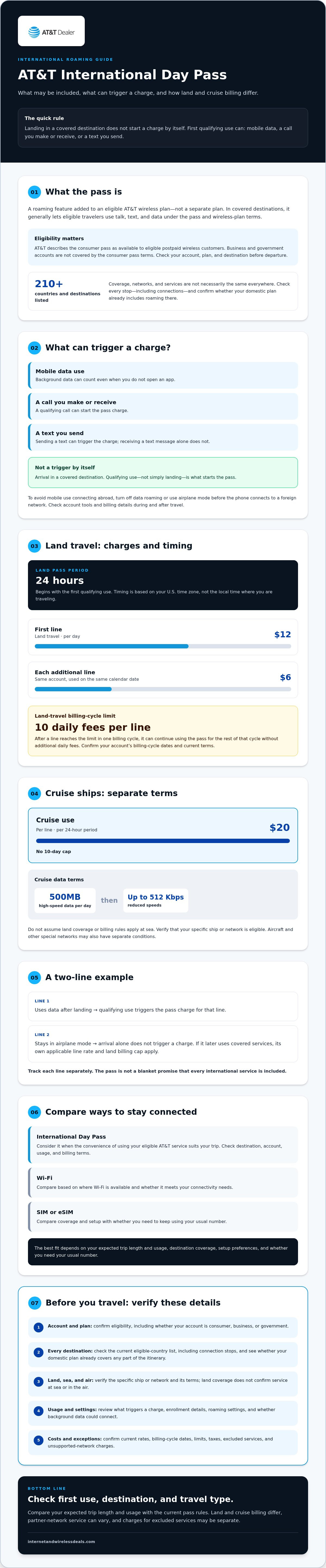
Using data, making or receiving a call, or sending a text can trigger the daily pass charge. Receiving a text message alone doesn’t trigger it. Other usage outside the pass’s included terms may have separate charges, so confirm how calls to different countries and any excluded services are treated under your account’s current terms.
Cruise use has separate conditions. AT&T’s current cruise terms specify 500MB of high-speed data per day, followed by reduced speeds of up to 512 Kbps. Don’t assume land coverage rules or usage terms apply at sea.
Where can AT&T International Day Pass be used?
AT&T lists coverage in more than 210 countries and destinations, but that doesn’t mean every destination, network, or service is supported in the same way. Check each stop on AT&T’s current eligible-country list, including connecting destinations. Also check whether your domestic plan already includes roaming in a place you’ll visit, as that may affect whether you need the pass.
Coverage depends on local partner networks, and service availability or performance can vary by destination. Cruise ships and aircraft may connect through separate networks with different terms or charges. Verify that the specific ship or network is eligible before using your phone. A country’s land coverage does not confirm service at sea or in the air.
How AT&T International Day Pass charges and usage rules work
The charge doesn’t start just because you land in a covered destination. AT&T says the first use of mobile data, a call you make or receive, or a text you send triggers the pass. Receiving a text by itself doesn’t. For land travel, the charge period runs for 24 hours from the first qualifying use, with timing based on your U.S. time zone, not the local time where you’re traveling.
For eligible postpaid consumer accounts, the land-travel rate is $12 per day for the first line and $6 per day for each additional line on the same account used on the same calendar date. The maximum is 10 daily fees per line in one billing cycle. Once a line reaches that cap, it can continue using the pass for the rest of that billing cycle without additional daily fees. Cruise-ship use has different terms: $20 per line per 24-hour period, with no 10-day cap.
When might a daily charge be triggered?
A phone connecting to mobile data abroad can use background data even if you don’t open an app, potentially triggering the pass. To avoid using it, turn off data roaming or use airplane mode before the phone connects to a foreign network. Check your AT&T account tools and billing details during and after travel to review pass activity. Arrival alone isn’t listed as a trigger, but qualifying use is.
What should travelers know about multiple lines and billing limits?
Consider a trip with two eligible lines. One traveler uses data after landing, while the other keeps the phone in airplane mode. The first line’s pass is triggered; arrival alone doesn’t trigger the second line. If both lines later use covered services, the additional-line rate and land billing cap apply according to AT&T’s terms. Track each line separately and confirm your account’s billing-cycle dates and current rules before departure.
The pass isn’t a blanket promise that every international service is covered. Taxes, charges for excluded services, and charges on unsupported networks may be separate. Cruise billing differs from land billing, and aircraft or other special networks may have their own conditions. Check the current terms for your itinerary and account. If you’re reviewing broader AT&T wireless plan options, compare your account’s eligibility and travel rules before deciding how you’ll connect.
AT&T International Day Pass vs. Wi-Fi, SIM, and eSIM options
Roaming lets you use your eligible AT&T line and existing number in supported destinations without swapping to a travel SIM. Wi-Fi, a local SIM, or an eSIM may suit other travel styles, but each requires checking access, compatibility, and setup. The best choice depends on your itinerary and usage.
Compare the options by asking how often you’ll need a connection away from lodging, whether you need your usual number for calls and texts, and how much setup you’re comfortable doing. Coverage can vary by destination and network, so no option guarantees the same experience everywhere.
When could a roaming pass be the more convenient choice?
AT&T International Day Pass features may appeal if you want to keep your existing number and account active while moving between destinations. You don’t need to select a local provider or switch SIMs just to access roaming, though eligibility and destination terms still apply. For a short trip or a multi-stop itinerary, weigh that convenience against the pass’s usage and billing rules. Don’t assume it costs less without comparing your expected use with current alternatives.
Keeping your primary number can make it easier to receive calls or messages on that line, subject to plan terms and network availability. Convenience doesn’t remove the need to manage settings. If you’re using another connection for data, confirm which SIM or network your phone will use so you don’t accidentally trigger AT&T roaming.
When should travelers consider Wi-Fi or a travel SIM?
Wi-Fi can work well if you mainly need connectivity in places with dependable access, such as lodging or other locations that offer a network. Availability and quality vary. Wi-Fi calling also depends on the network, device settings, and whether the feature is supported for your line and destination. Check those details before relying on Wi-Fi for important calls.
A local SIM or travel eSIM may be worth researching if you expect frequent data use and are comfortable arranging another service. Before choosing one, confirm that your phone supports the SIM format and can use the intended provider, and that the offer covers every destination on your route. Review data limits, calling and texting options, and setup steps. If a second SIM is active, check your device’s cellular settings carefully to prevent unintended AT&T data use.
Make an itinerary-based comparison: roaming favors continuity and minimal setup, Wi-Fi depends on access points, and SIM or eSIM options require compatibility checks and advance research. If you’re also reviewing AT&T wireless plan options, consider how your current plan fits your travel needs before departure.
How to prepare your AT&T phone before international travel
A pre-trip check can help confirm that your account, destinations, and phone are ready before your first connection abroad. Work through these steps in order. AT&T International Day Pass features and eligibility depend on your account and current terms, so verify the details directly with AT&T before traveling.
What to check before leaving the United States
- Confirm account eligibility. Check that your account qualifies for the consumer pass and review any plan-specific conditions. The consumer pass is for eligible postpaid accounts; business and government accounts have separate terms.
- Check every destination. Look up each country or territory on AT&T’s current eligible-destination list. If your trip includes a cruise or flight, verify the specific ship or network rather than assuming land coverage applies.
- Review enrollment and pass terms. Use your AT&T account or contact AT&T to confirm whether the pass is available and active on your line. Review current usage and billing rules, rather than relying on an old confirmation or terms saved from a previous trip.
- Prepare your device. Confirm that your phone can connect to international networks and check its cellular, data-roaming, and SIM settings. Menu names differ by device and software version, so consult your phone maker’s instructions if needed.
- Save account access details. Make sure you can sign in to your AT&T account while away. Save relevant support contact information and account-management details somewhere you can access without mobile data.
If you’re reviewing your plan before departure, use this AT&T Wireless Plans 2026 comparison guide as a starting point, then verify plan terms with AT&T.
How to monitor usage and avoid surprises while traveling
Once abroad, check your account’s usage and billing activity through AT&T’s app or website. The screens may change, so look for current usage, international roaming, and charges rather than expecting a particular menu layout. Review activity after connecting and as your trip continues, especially if several lines share the account.
Pay attention to the network name displayed on your phone when crossing borders or moving between land, sea, and air. If you’re unsure whether a network is covered, pause mobile data use and confirm the terms with AT&T before calling, texting, or browsing. Qualifying use, not simply arriving, can trigger a daily pass charge. If you plan to avoid the pass, adjust roaming settings before the phone connects.
For a closer look at AT&T wireless options, review available AT&T wireless plans and confirm travel eligibility and conditions for your account.
Is AT&T International Day Pass right for your trip?
The pass may suit travelers who value convenience and want to keep using an eligible AT&T account and existing number abroad. It can be appealing if you’re visiting several destinations and prefer not to arrange a separate connection at each stop. First confirm that your account, every destination, and the network you’ll use are covered under current terms.
Trip length and phone habits matter, too. If you expect frequent cellular data use or regular calls, consider how repeated pass use fits your itinerary and billing-cycle rules. If you’ll mostly use reliable Wi-Fi, travel for an extended period, or mainly need data, compare compatible SIM or eSIM alternatives before deciding. Don’t assume one option is cheaper without comparing your likely usage and the applicable terms.
Who may benefit from the pass’s convenience?
It may be a practical fit if you want to manage travel connectivity through your existing AT&T account and minimize SIM setup. Multi-stop trips can make that simplicity attractive, but check each country, territory, cruise ship, or other network separately. AT&T International Day Pass features and availability aren’t universal, and account eligibility and plan conditions still apply.
What should you confirm before choosing AT&T for travel?
Use this checklist to match the pass to your trip:
- Destinations: Are all stops on the current eligible list, including any cruise or flight connections?
- Lines: Which account lines may use the pass, and how do the current additional-line and billing-cycle rules apply?
- Device: Is your phone compatible with the networks and settings you expect to use?
- Connectivity needs: How much cellular data, calling, and texting do you expect, and where can you rely on Wi-Fi?
Before you travel, review the latest pass terms and confirm account-specific eligibility and enrollment directly with AT&T. Then compare your expected usage with Wi-Fi and compatible SIM or eSIM options. If you’re also reviewing your domestic plan, explore AT&T wireless plan options and verify the details that apply to your account.
Make your travel connectivity plan before you go
AT&T International Day Pass features can offer a convenient way to stay connected through an eligible account, but the right fit depends on your itinerary and phone habits. Confirm your plan’s eligibility, check every destination and special network, and understand which activities can trigger charges. Then compare the pass with Wi-Fi or a compatible SIM or eSIM based on your expected calls, texts, and data use.
Prepare by reviewing current terms with AT&T, checking your phone settings, and making sure you can access your account while away. Internet and Wireless Deals is an independent third-party marketing partner and authorized AT&T retailer that helps customers review AT&T wireless options. Explore AT&T wireless plan options as you plan your trip, then verify the details that apply to your account.
Frequently Asked Questions
What does AT&T International Day Pass include?
It lets eligible postpaid consumer wireless customers use talk, text, and data in covered destinations under the pass and their plan’s terms. The exact AT&T International Day Pass features depend on the account, destination, and network, so check current terms before traveling. Cruise use has separate conditions, including a daily high-speed data allowance followed by reduced speeds. Business and government accounts aren’t eligible for the consumer pass.
How much does AT&T International Day Pass cost per day?
For eligible consumer accounts on land, the charge is $12 per day for the first line and $6 per day for each additional line used on the same account on the same calendar date. Eligible cruise-ship use costs $20 per line per 24-hour period. Land travel has a maximum of 10 daily fees per line in one billing cycle; cruise use has no 10-day cap. Confirm current terms for your account.
Do I have to use my phone for AT&T International Day Pass to charge me?
Qualifying use triggers the daily charge, but simply arriving in a covered destination doesn’t. AT&T says using data, making or receiving a call, or sending a text can start the pass. Receiving a text alone won’t. Background app activity may use data, so turn off data roaming or use airplane mode if you want to avoid triggering the pass, and check account activity while traveling.
Can I use AT&T International Day Pass on a cruise ship or airplane?
The pass can be used on eligible cruise ships, but cruise terms differ from land terms. AT&T lists more than 400 eligible ships; cruise use includes 500MB of high-speed data per day, then speeds are reduced to a maximum of 512 Kbps. Don’t assume an airplane network is covered. Check the specific ship or network and its charges before using your phone at sea or in the air.
Does AT&T International Day Pass work in every country?
No. AT&T says land coverage includes more than 210 countries and destinations, but not every place or network is necessarily supported. Check every stop on your itinerary against AT&T’s current eligible-destination list, including connecting destinations. Coverage and network availability can vary. Also check whether your domestic wireless plan already includes roaming at a destination before deciding whether you need the pass.
Can multiple lines on one AT&T account use International Day Pass?
Eligible lines on the same consumer account can use the pass. For land travel, the first line is charged $12 per day, and additional lines used on the same calendar date are charged $6 per day each. The land billing-cycle cap applies per line, with a maximum of 10 daily fees per line. Check eligibility, billing dates, and current rules for your account before traveling.
Is AT&T International Day Pass better than using a travel eSIM?
It depends on your itinerary, phone, and connectivity needs. The pass may be convenient if you want to use an eligible AT&T line and keep your existing number without setting up a separate SIM. A travel eSIM may suit travelers focused on data, but it requires a compatible device, destination research, and careful cellular settings. Compare coverage and terms, and make sure your phone doesn’t use AT&T data unintentionally.


