

The plan with the biggest “unlimited” label may not be the best 5G wireless plan for you. The right fit depends on whether its coverage, high-speed data, and hotspot terms match how you use your phone.
Plan names don’t always make it clear how much high-speed data is included, when speeds may be reduced, or what you can do with a hotspot. And 5G availability depends on your location and compatible device, so check coverage and your phone’s specifications as well as the plan details.
This guide explains what to compare before you switch, including data use, hotspot needs, network management, and plan terms. You’ll learn how to verify coverage and device compatibility, compare options such as AT&T wireless plans, and check for limitations that could affect your experience. Use your own routine as the starting point, rather than choosing based on a headline claim.
Key Takeaways
- Distinguish mobile 5G phone service from 5G home internet so you compare the right type of connection.
- Check that your phone supports the network’s 5G bands, then review coverage where you live, work, commute, and travel.
- Look beyond plan labels: compare high-speed data, hotspot allowances, network-management terms, and eligibility.
- Find the best 5G wireless plan for your needs by matching its features to your actual data use and coverage priorities.
- Assess current AT&T wireless options against your checklist, then verify plan details and eligibility before enrolling.
What Is a 5G Wireless Plan vs. 5G Home Internet?
A 5G wireless plan provides mobile phone service through a cellular network. With a compatible phone, you can make calls, send messages, and use mobile data while away from home. The best 5G wireless plan is one that fits your phone use and works where you need it, not simply one with 5G in its name.
In short: Mobile 5G connects a compatible phone to a cellular network. 5G home internet uses a fixed home setup to provide an internet connection for a household. Both use 5G technology, but they serve different needs. For a broader overview of how the technology works, see 5G technology.
How Does Mobile 5G Differ from 5G Home Internet?
Mobile 5G is designed to travel with your phone. Your choice of plan typically depends on the number of phone lines you need, how you use mobile data, and where you need service, such as at home, work, on your commute, or while traveling. Coverage and performance can vary from place to place.
5G home internet is intended to connect a household from a fixed location. It is separate from phone data, even though both use a cellular network. If you’re exploring internet for your home, see the existing guide to AT&T Internet Air for more on that option.
What Does 5G Change for Everyday Phone Use?
A 5G connection can support everyday tasks such as streaming video, downloading files, using navigation, and running connected apps. How those activities feel depends on more than the 5G label. Your location, network congestion, phone capabilities, and current network conditions can all affect the connection.
That’s why it’s worth checking a plan’s coverage and terms closely. 5G access depends on a compatible device, coverage where you use your phone, and the details of the plan. A 5G icon alone doesn’t guarantee the same experience everywhere. Check coverage in the places you regularly go, confirm that your phone supports the network, and compare how each plan handles data and hotspot use. These checks help you assess the best 5G wireless plan for your routine instead of relying on a headline claim.
How 5G Wireless Plans Work: Coverage, Data, and Compatible Phones
A 5G plan connects your phone to a carrier’s cellular network when you’re in range and using a compatible device. But a plan that lists 5G doesn’t guarantee a particular speed everywhere. Your mobile 5G experience depends on coverage, your phone’s network and band support, your plan terms, and conditions such as congestion.
For a consumer-friendly overview of 5G and how it differs from earlier mobile technology, the FCC explains 5G. When comparing plans, focus on what the technology means in the places you use your phone and under the terms you’ll actually have.
Why Do Coverage and Phone Compatibility Matter?
Start with the places that matter to your routine: home, work, your commute, and destinations you visit often. Review the provider’s current coverage information for each. Maps are useful guides, but a signal can vary within an area, including between indoor and outdoor spaces.
Your phone matters, too. It needs to support the carrier’s network technology and relevant frequency bands to access its 5G service. Before switching or buying a device, ask the provider to confirm current coverage and compatibility requirements for your specific phone model.
What Should You Check Beyond the Word Unlimited?
“Unlimited” describes a plan’s data offer, but it doesn’t automatically tell you how much data receives high-speed treatment or what may happen during congestion. Read the plan terms for high-speed data thresholds and network-management conditions. These explain whether and when a carrier may temporarily manage data speeds on its network.
Check hotspot allowances separately. Hotspot data lets your phone share its mobile connection with other devices, but its allowance and conditions may differ from the data you use directly on your phone. If you travel internationally, review included destinations, roaming terms, and any usage limits rather than assuming domestic plan details apply abroad.
- Plan data: How the plan handles phone data and any high-speed usage threshold.
- Network management: Conditions that may affect data performance, such as network congestion.
- Hotspot: The amount of data available for connecting other devices and any related limits.
- Travel features: Whether international use or roaming fits your plans and what terms apply.
These details can vary by plan and may be updated, so verify current terms before enrolling. If you’re considering AT&T, you can review AT&T wireless plan information through Internet and Wireless Deals, an independent third-party marketing partner and authorized AT&T retailer. Check current coverage, device requirements, plan features, and eligibility before deciding which option fits.
How to Compare 5G Wireless Plans Without Being Misled by Plan Labels
A tier name or “unlimited” headline can make plans sound more alike than they are. Compare the details that affect your everyday use, and verify them in each provider’s current plan terms. The best fit depends on coverage, data rules, hotspot needs, device compatibility, and eligibility, not on which label sounds most impressive.
| What to compare | What to check | Why it matters |
|---|---|---|
| Coverage | Does the provider show service where you live, work, commute, and travel? | A plan can only serve your needs where its network is available. |
| Phone data | Are there high-speed data thresholds or network-management terms? | These terms can affect data performance, including during congestion. |
| Hotspot use | How much hotspot data is included, and what conditions apply? | Phone data and data shared with other devices may have different terms. |
| Device needs | Does your phone support the provider’s network technology and bands? | An incompatible device may not access the provider’s 5G service as intended. |
| Eligibility | Do any plan features or offers have conditions you need to meet? | Eligibility can affect which options are available to you. |
Is Unlimited Data Really Unlimited?
“Unlimited” doesn’t mean every plan handles data in the same way. A plan may include unlimited phone data while also listing high-speed data thresholds or network-management conditions. Hotspot data is another detail to inspect: its allowance and limits may differ from phone data. Check the current plan disclosure for both before deciding, and don’t assume a feature based on the tier name.
Which Plan Features Matter for Different Users?
If you stream video or download large files often, focus on high-speed data terms and network-management conditions. If you regularly connect a laptop or tablet through your phone, examine hotspot allowances first. If your phone use is more occasional, compare the features you expect to use and confirm eligibility. This approach helps you identify the best 5G wireless plan for your routine without relying on labels alone.
Use the table as a side-by-side checklist. Put each provider’s current terms into the same categories, then flag anything unclear for confirmation before enrollment. Comparing like with like makes it easier to spot meaningful differences and avoid treating “unlimited,” “premium,” or another headline as a complete description of what’s included.
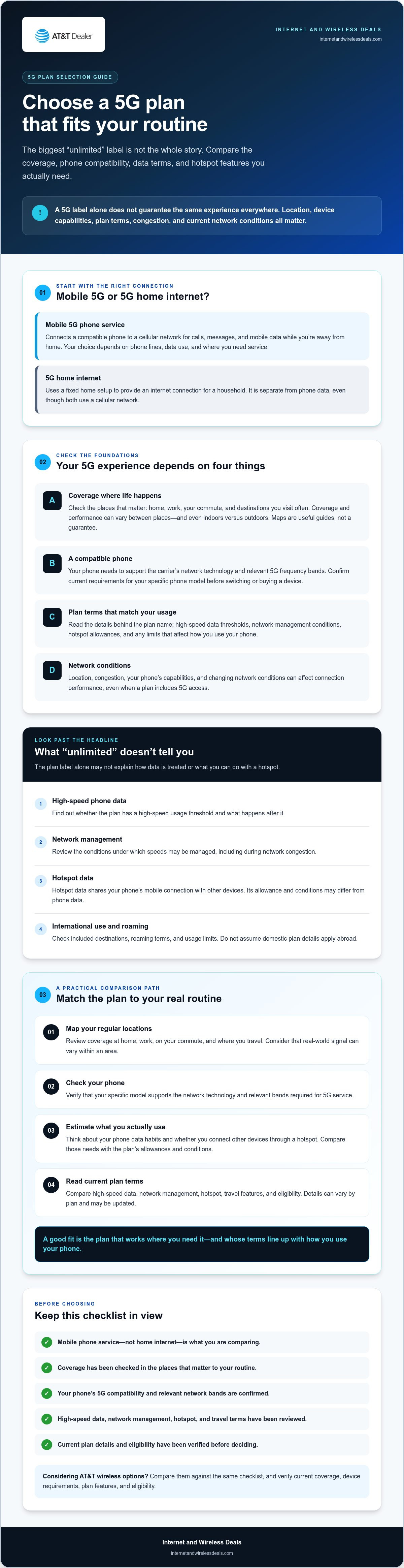
How to Choose the Best 5G Wireless Plan for Your Needs
Start with your routine, not a carrier’s headline. These steps can help you narrow your options and check details that may affect your service and monthly bill.
- List your usage. Note how often you stream, download, use navigation, or connect other devices through your phone. Include the number of lines you need.
- Verify coverage. Check service in the places you regularly go, including home, work, your commute, and frequent travel destinations.
- Check your device. Confirm with the provider that your phone supports its 5G network and relevant bands.
- Compare current terms. Review high-speed data, hotspot allowances, network-management conditions, and any features you actually need.
- Confirm eligibility and total cost. Review line requirements, offer conditions, and the full recurring bill, including applicable charges. Don’t rely on a headline offer alone.
For an AT&T-specific comparison, use the existing AT&T wireless plans comparison guide alongside this checklist. Verify current plan information before making a decision.
How Can You Check Whether 5G Coverage Fits Your Routine?
Identify the places where mobile service matters most, then use the provider’s current coverage tools to check them. Treat maps as estimates, not guarantees. Indoor signal and local network conditions can affect your experience. Before switching, confirm your phone’s compatibility and ask the provider about relevant coverage or device limitations.
What Should You Confirm Before You Switch?
Read the current plan terms closely. Confirm line requirements, eligibility, and any conditions tied to a time-limited offer. If a device payment or transfer is part of your situation, check its details directly rather than assuming how it works. Compare the recurring bill and included features with your needs before enrolling.
The best 5G wireless plan is the option that fits your usage, coverage priorities, and budget, with terms you understand. If AT&T is on your shortlist, you can review available AT&T wireless options through Internet and Wireless Deals, an independent third-party marketing partner and authorized AT&T retailer. Check current plan details and eligibility before enrolling.
Review AT&T 5G Wireless Options and Take the Next Step
AT&T wireless plans are one option to assess against your coverage, data, hotspot, and device checklist. Current plan details can help you identify possible fits, but no tier is automatically right for every user. Compare the latest terms and confirm eligibility before deciding.
What Should You Verify in Current AT&T Plan Details?
AT&T’s current Unlimited Your Way options include Value 2.0, Extra 2.0, and Premium 2.0. Their data and hotspot terms differ:
- Value 2.0: Includes unlimited talk, text, and data, with 5GB of high-speed data and 3GB of hotspot data. After 5GB, data speeds may be slowed.
- Extra 2.0: Includes 100GB of high-speed data and 50GB of hotspot data. After 100GB, speeds may be temporarily reduced during network congestion. Video streams at standard definition.
- Premium 2.0: Includes unlimited high-speed data that isn’t subject to slowdowns based on usage, 100GB of high-speed hotspot data, and support for 4K UHD video streaming. It also includes unlimited talk, text, and high-speed data in 20 Latin American countries.
AT&T also lists Build-A-Plan, a modular option with choices for data and hotspot. Confirm its current terms along with the Unlimited Your Way details. Check plan names, data limits, hotspot conditions, streaming terms, device requirements, and any international features against current information. Offers and eligibility conditions can vary, so don’t assume a particular plan or feature is available to everyone.
How Can You Move from Comparison to Sign-Up?
Make one final check against your priorities: coverage where you use your phone, a compatible device, the amount of data you need, and terms that suit your habits. If you rely on hotspot data or travel internationally, verify those specific conditions before enrolling. Review the full current bill and any applicable requirements as well.
Internet and Wireless Deals is an independent third-party marketing partner and authorized AT&T retailer. The site helps customers review AT&T wireless offers and connect with sign-up options, and it may earn a commission from successful wireless activations. It doesn’t directly operate AT&T wireless service.
Ready to compare the details with your checklist? Review available AT&T wireless options, confirm current plan information and eligibility, then decide whether to enroll. The best 5G wireless plan is the one that fits your needs and has terms you understand.
Choose a 5G Plan That Fits Your Everyday
The right plan isn’t defined by a 5G label or an “unlimited” promise. It’s the one that matches how you use your phone and where you need service. Check coverage in the places you go, make sure your device is compatible, and compare high-speed data, hotspot allowances, network-management terms, and eligibility before switching.
Keep your own usage at the center of the decision. That’s how you find the best 5G wireless plan for your routine, with terms you understand and features you’re likely to use.
Ready to assess AT&T as an option? Internet and Wireless Deals is an authorized AT&T retailer and independent marketing partner. The site helps customers across the United States review AT&T wireless options and connect with sign-up opportunities. Review current plan information and eligibility before deciding whether to enroll.
Review current AT&T wireless options and find a plan that fits. Take the next step with a clear idea of what matters most to you.
Frequently Asked Questions
What is the best 5G wireless plan?
The best 5G wireless plan is the one that fits your coverage needs, phone, data use, and budget. Start by checking service where you live, work, commute, and travel. Then compare high-speed data terms, hotspot allowances, network-management conditions, and eligibility. A plan’s name or “unlimited” label won’t tell you everything. Check current provider terms before you switch, since features and conditions can vary between plans.
Is a 5G wireless plan the same as 5G home internet?
No. A 5G wireless plan provides mobile service for a compatible phone through a cellular network. 5G home internet is a fixed connection intended to serve a household from a home location. Both use 5G technology, but they’re designed for different needs. Compare a mobile plan for phone lines, data use, and travel. Consider home internet separately if you’re looking for a connection for household devices.
Is unlimited data really unlimited on a 5G plan?
Not always in the sense of unlimited high-speed performance under every condition. An unlimited plan may include terms that allow speeds to be temporarily managed, such as during network congestion, or specify a high-speed data threshold. These conditions vary by plan. Check hotspot data separately, too, since it may have its own allowance. Read the current plan disclosure to understand how phone data and hotspot use are handled.
How do I check whether 5G coverage is available where I live?
Use the provider’s current coverage map or address-checking tool to review service where you live. Check other places you rely on, such as work, your commute, and frequent destinations. Coverage maps are estimates, not guarantees; signal can vary indoors and with local network conditions. If anything is unclear, ask the provider to confirm coverage for your location and explain relevant limitations before you switch.
Can I use any 5G phone with any 5G wireless plan?
No. A phone needs to support the provider’s network technology and relevant frequency bands to access its 5G service. A device described as 5G-compatible may not support every carrier’s bands. Before switching or purchasing a phone, confirm its exact model with the provider and check current compatibility requirements. Also verify that your plan and device can be used together as intended.
What should I compare when choosing a 5G wireless plan?
Compare coverage in the places you use your phone, device compatibility, high-speed data terms, hotspot allowances, network-management conditions, and eligibility. Check whether features such as international use matter to you, and confirm their terms rather than assuming they’re included. Review the full recurring bill and applicable conditions before enrolling. A side-by-side comparison using current provider information can reveal differences that plan labels alone may hide.
Does a 5G wireless plan include mobile hotspot data?
Some plans include hotspot data, but the amount and conditions depend on the specific plan. Hotspot data is used when your phone shares its mobile connection with another device, such as a laptop. Its allowance may differ from data used directly on your phone, even if the plan is described as unlimited. Check current plan terms for the hotspot amount, applicable limits, and whether the feature is included.


