

What if the right home internet plan isn’t the fastest tier, but the one that keeps your household connected without paying for speed you rarely use? The AT&T Fiber 500 plan offers symmetrical download and upload speeds of up to 500 Mbps. Whether that’s a good fit depends on how many people share the connection and what they do online at the same time.
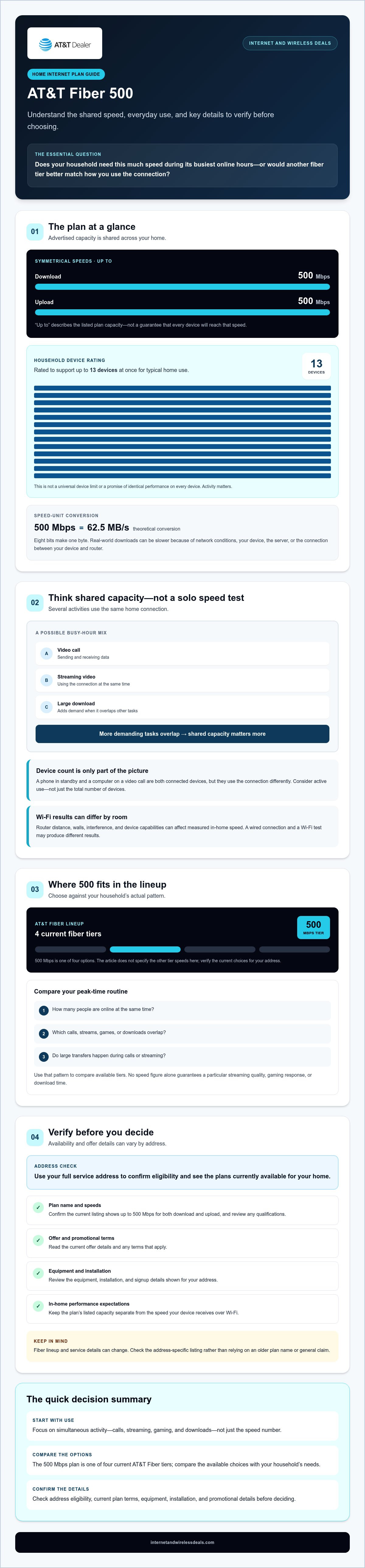
It’s easy to focus on the speed figure or a current offer and overlook the details that shape everyday value. AT&T streamlined its fiber lineup on June 7, 2026, and the 500 Mbps tier is now one of four options. It’s rated to support up to 13 devices at once for typical home use, though actual performance can vary with your setup and activities.
This guide explains what the plan’s speed can support, how it compares with AT&T’s other fiber tiers, and which terms to check before signing up. You’ll also learn how to confirm current plan names, offers, equipment and installation details, and address-level availability, so you can choose for your household rather than by headline speed alone.
Key Takeaways
- Judge 500 Mbps by your household’s mix of video calls, streaming, gaming, and downloads, not the speed figure alone.
- The AT&T Fiber 500 plan is one of four current fiber tiers; compare the options against your home’s needs before choosing.
- Use your full service address to confirm eligibility and see which plan names and signup options are currently available.
- Before signing up, review the offer’s terms, including any applicable equipment, installation, and promotional details.
What Is the AT&T Fiber 500 Plan, and What Does 500 Mbps Mean?
The AT&T Fiber 500 plan is a residential fiber internet tier with advertised download and upload speeds of up to 500 Mbps each, subject to availability and plan terms. Because the listed capacity is the same in both directions, symmetrical speeds can be useful for activities that send data as well as receive it. They don’t mean every device will reach 500 Mbps.
Mbps means megabits per second, a measure of how much data a connection can transfer over time. It differs from megabytes per second (MB/s): eight bits make one byte, so 500 Mbps converts to a theoretical 62.5 MB/s before real-world factors. Actual downloads can be slower because of network conditions, your device, the server, or the connection between your device and router.
What does a 500 Mbps internet plan mean?
Think of the plan’s capacity as shared space for your household’s online activity. If one person joins a video call while another streams video and a device downloads a large file, all three activities use the same connection. The more demanding tasks overlap, the more that shared capacity matters. The plan speed alone can’t guarantee a particular streaming quality, gaming response, or download time.
Wi-Fi adds another factor. Distance from the router, walls, interference, and device capabilities can affect the speed measured in a room, even when the connection entering the home supports the listed plan speed. A wired connection and a Wi-Fi test may produce different results.
What should you verify in the AT&T Fiber 500 listing?
Check the listing for your specific address before deciding. AT&T’s fiber lineup and service details can change, so confirm the plan name and current speed specifications rather than relying on an older page or general claim. For background on the company’s internet services and fiber technology, see this overview of AT&T Fiber.
- Download and upload: Confirm that the listing shows up to 500 Mbps for both.
- Qualifications: Review any terms that apply to the advertised speeds or plan.
- In-home performance: Distinguish the plan specification from the speed your devices receive over Wi-Fi.
- Current details: Check the plan name and clarify any terms that are unclear or may have changed during address-based signup.
Availability and displayed options can vary by service address. Verify the listing for your home before assuming a plan specification is an offer you can order.
How Well Can the AT&T Fiber 500 Plan Handle Everyday Internet Use?
A speed tier is only part of the picture. To judge whether 500 Mbps fits, consider who uses the connection, how many devices are active at once, and what they’re doing during your household’s busiest hours. A home with several connected devices used mostly for browsing may have different needs from one where people regularly join video calls, stream entertainment, and download large files at the same time.
The AT&T Fiber 500 plan is rated to support up to 13 devices simultaneously for typical home usage, but that figure isn’t a universal limit or a promise of identical performance on every device. A connected device that’s idle uses the connection differently from one actively streaming or downloading. For more context on how fiber speeds relate to household use, read this fiber internet speed guide.
Is 500 Mbps enough for streaming, gaming, and video calls?
These activities can all be part of the same household routine, but no speed tier guarantees a particular experience in every setup. A video call, online game, and entertainment stream may all be in use during the evening. Large downloads at the same time add to the demand on the shared connection. Your device, app settings, and service requirements also matter. The FCC’s Broadband Speed Guide offers reference points for common online activities. Use those alongside your own usage rather than expecting one speed figure to settle the question.
Make a quick peak-time inventory: note how many people are online, which activities overlap, and whether large transfers happen during calls or streaming. That pattern tells you more than simply counting every device in the home.
How many devices can use the plan at once?
Device count alone doesn’t show how much capacity a household needs. A phone in standby and a computer on a video call both count as connected devices, but their active use differs. Consider what each person typically does online at the same time, then compare that pattern with the plan’s verified specifications. Don’t treat a device rating as a guarantee that every activity will run at peak speed.
Also distinguish the wired connection from Wi-Fi coverage. A device connected by Ethernet may perform differently from one across the home, where distance, walls, router placement, and device capability can affect results. If performance varies by room, the cause may be the in-home Wi-Fi link rather than the plan’s listed speed. Review address-specific details and current terms before choosing. Internet and Wireless Deals provides a way to review AT&T Fiber options and availability.
AT&T Fiber 500 Compared With Other Tiers: Which Fits Your Needs?
AT&T’s fiber lineup has four listed speed tiers: 300 Mbps, 500 Mbps, 1 Gbps, and 5 Gbps. The right choice depends on how much capacity your household can use, not simply which tier has the biggest number. Use this comparison as a starting point, then confirm specifications and eligibility for your address.
| Tier | Listed speed | A potential fit to consider |
|---|---|---|
| 300 Mbps | 300 Mbps | Households with lighter concurrent demand that want to compare a lower tier. |
| 500 Mbps | Up to 500 Mbps download and upload | Households balancing several active users and everyday online tasks. |
| 1 Gbps | 1 Gbps | Homes with heavier simultaneous use or frequent large transfers that may benefit from more capacity. |
| 5 Gbps | 5 Gbps | Households with particularly high capacity needs and compatible equipment and devices. |
All AT&T Fiber tiers include unlimited data, according to the current plan information. The 5 Gbps tier includes All-Fi Pro; it’s available as an add-on for other plans. Confirm the exact terms shown for your address, since equipment, add-ons, and displayed plan details may vary. For a broader look at current offer details, see this AT&T Fiber deals guide.
When might the 500 plan be a practical middle option?
The AT&T Fiber 500 plan may be worth comparing if your home has overlapping online activities but you don’t have a clear need for a higher tier. If your current service handles busy periods comfortably, a lower option may be worth considering. If calls, entertainment, and large transfers often compete for capacity, compare the higher tiers too. There’s no universal best choice; the FCC household broadband guide offers a framework for thinking about how much internet speed you really need.
How should you compare the 500 plan with gigabit service?
Gigabit service lists 1 Gbps, twice the 500 Mbps tier’s advertised speed. That added capacity matters most when household activity can use it, such as frequent large downloads or many demanding tasks at once. It may matter less if your devices and habits rarely use the capacity you already have. Explore this 1 Gig plan guide, then review current AT&T Fiber options and address-level availability through AT&T Fiber offer and availability information.
How to Check AT&T Fiber 500 Availability and Review the Offer
Start with your exact service address. Fiber availability can vary even within a broader service area, and the options shown for one address may not appear for another. Use the address-based results to confirm whether the AT&T Fiber 500 plan is currently offered at your home. For a broader overview of how to check coverage, see this fiber availability map guide.
What details should you confirm before ordering?
Review the offer itself, not just a general plan description. Promotions and terms can change, so check what applies to your address before submitting an order.
- 1. Confirm the plan: Check the exact plan name, advertised download and upload speeds, and any qualifications shown.
- 2. Review recurring charges: Note the monthly charge displayed and whether it depends on eligibility, billing choices, or other conditions.
- 3. Check one-time charges: Look for any installation or other upfront charges listed for your order. Don’t assume they’re waived or included.
- 4. Read promotion terms: Confirm the offer’s duration, eligibility requirements, and what the charge becomes after a promotional period, if applicable.
- 5. Verify equipment and installation: Check what equipment is included, whether any monthly equipment charge applies, and what installation arrangement is specified.
- 6. Save the terms: Keep a copy or screenshot of the offer details you reviewed, including any conditions or service terms.
If a key detail is missing or unclear, confirm it through the signup process before ordering. Address-specific results are the best place to verify available plans and current terms.
What if the 500 plan is not offered at your address?
Use the results for your address to see which current AT&T Fiber tiers, if any, are available. Compare those options with your household’s needs before considering another connection type. AT&T Internet Air is a separate service, not a fiber tier; its AT&T Internet Air guide can help you understand that alternative.
Internet and Wireless Deals is an independent third-party marketing partner and authorized AT&T retailer, not AT&T itself. Check AT&T Fiber availability and current offers, then verify the final terms shown for your service address.
Is AT&T Fiber 500 Right for You? Take the Next Step
The AT&T Fiber 500 plan may be worth comparing if your household has several people online and you want to weigh a middle speed tier against lighter or higher-capacity options. The fit depends on what everyone does during your busiest hours, which plan details are available at your address, and the offer’s full cost over time. If price is a priority, compare the recurring charge and any promotional conditions, not just the headline offer. No tier is the right choice for every home.
Use this quick checklist before choosing
- Map peak use: Consider which activities overlap during your busiest hours, such as calls, entertainment, and large downloads.
- Check the specifications: Match those habits against the verified download and upload speeds and any qualifications in the current plan listing.
- Compare local options: Review the 500 tier alongside the AT&T Fiber alternatives shown for your service address. A plan available elsewhere may not be offered at your home.
- Review the complete offer: Recheck recurring charges, one-time charges, promotion conditions, equipment, installation arrangements, and applicable service terms before ordering.
If your current connection handles simultaneous household activity comfortably, compare whether a lower tier meets your needs. If busy periods regularly strain your connection, consider whether a higher listed tier offers useful additional capacity. Verify all plan specifications rather than choosing by speed label alone.
How to move from comparison to signup
Internet and Wireless Deals is an independent third-party marketing partner and authorized AT&T retailer. Its online experience helps customers review AT&T Fiber offers, check address-level availability, and access signup options. Address-specific results show which plans can be considered, but they don’t guarantee eligibility or any particular offer.
Before submitting an order, read the final terms presented for your address. Confirm the plan name, speeds, charges, promotion conditions, equipment, and installation details. Make sure the offer still matches your needs and budget. Check the final options and terms before activation.
Ready to compare? Visit Internet and Wireless Deals to review current AT&T Fiber offers and check availability for your address, then confirm the displayed terms before moving forward.
Choose Your Next Step with Confidence
The AT&T Fiber 500 plan offers advertised speeds of up to 500 Mbps for downloads and uploads, but the best fit depends on your household’s busiest online hours, connected devices, and expectations. Compare it with the other fiber tiers available at your address rather than choosing by speed number alone. Then review current charges, promotion conditions, equipment, installation details, and service terms before ordering.
Availability and offers can vary by address and may change. Check the specific options shown for your home, and make sure the final terms match your needs and budget. Internet and Wireless Deals is an independent third-party marketing partner and authorized AT&T retailer. Its site helps customers check availability and review current AT&T service offers.
Ready to see what’s available? Check AT&T Fiber availability and review current offers, then confirm the details for your address before choosing. A careful comparison can help you move forward with confidence and find a plan that fits your household.
Frequently Asked Questions
Is AT&T Fiber 500 fast enough for a household?
It may be, depending on how many people use the connection at once and what they’re doing. The AT&T Fiber 500 plan is listed with symmetrical speeds of up to 500 Mbps, but that doesn’t guarantee a particular experience on every device. Consider busy periods when streaming, video calls, and downloads overlap. Check the current offer’s speed specifications for your address, and assess Wi-Fi coverage separately from the plan’s connection capacity.
What does 500 Mbps mean for internet speed?
500 Mbps means a connection capacity of up to 500 megabits per second, not a promise that every device will receive that exact rate. Mbps measures megabits, while MB/s measures megabytes; eight bits make one byte. Actual results can vary with Wi-Fi, device capability, network conditions, and whether you’re connected wirelessly or by cable. Before relying on an AT&T-specific speed figure, verify the listing and any qualifications for your address.
How much does the AT&T Fiber 500 plan cost?
Check the current, address-specific offer for the plan’s price, since advertised pricing and promotions can change. Don’t rely on an older listing or assume a discount applies to your order. Review the full offer before signing up, including recurring charges, any one-time charges, the promotion’s duration and conditions, and equipment and installation terms. If a charge or condition isn’t clear, confirm it during signup rather than estimating your total from a headline offer.
Is AT&T Fiber 500 available at my address?
Availability depends on your exact service address. A plan offered at one address may not be available at another, even within the same broader service area. Use the provider’s current address-based availability process to see whether the 500 Mbps tier is offered at your home. The results can also show which plans and terms are currently available there. Don’t assume eligibility based only on a city or ZIP code.
Can I use the AT&T Fiber 500 plan for gaming and video calls?
Gaming and video calls are common uses for fiber internet, but their performance depends on more than plan capacity. Your device, connection method, home Wi-Fi coverage, network conditions, and other active users can all matter. Latency, which affects how quickly data responds, is different from download speed. No plan can promise lag-free gaming or uninterrupted calls in every setup. Check current specifications, and investigate Wi-Fi conditions if performance falls short of expectations.
What is the difference between AT&T Fiber 500 and gigabit service?
The listed 500 Mbps tier offers up to 500 Mbps download and upload, while the current 1 Gbps tier lists higher speed capacity. That difference may matter for households with heavier simultaneous demand or frequent large transfers, but not every home needs the larger tier. Compare the current specifications and terms for both options at your address. Avoid deciding by speed alone; consider which activities overlap and whether your devices can use the added capacity.
What happens if AT&T Fiber 500 is not available at my address?
The address check may display other AT&T Fiber tiers or different AT&T connection options, but what appears depends on your address. Compare the fiber plans shown first, then review another available service as a separate option rather than assuming it works the same way. For broader guidance on checking coverage, see this fiber internet availability map guide. Don’t assume a rollout date or future eligibility unless confirmed by current information.


