

What if the fastest AT&T Fiber plan isn’t the best fit for your home? Comparing AT&T fiber plans and pricing means looking beyond the speed tier to the offer terms and ongoing monthly charge. And a plan that looks right on paper may not be available at your service address.
Two questions can help you narrow your options: which plan suits your household, and what will you pay beyond the advertised offer? This guide explains how to compare available plans, match speeds to everyday use, and review the pricing details that matter before you sign up. It also shows how address-based availability affects your choices.
Internet and Wireless Deals is an independent authorized AT&T retailer that helps customers review AT&T Fiber options and pursue sign-ups. Use this guide to weigh household needs against promotional terms, AutoPay and paperless billing requirements, and other details that can affect your monthly bill. Choose based on the full offer, not just the biggest speed number.
Key Takeaways
- Start with your service address, because it determines which AT&T Fiber options you can compare.
- Match download and upload speeds to your household’s everyday activities.
- Look beyond the advertised offer to understand AT&T fiber plans and pricing.
- Review offer duration, eligibility, equipment, and disclosed fees to understand the potential bill.
- Before signing up, check the selected tier and final billing terms. Availability and enrollment details can change.
AT&T Fiber availability and options
Which AT&T Fiber plans can you order at your address, and what monthly cost does the offer show? Start by checking eligibility. The service address determines which options appear, so a general idea of coverage isn’t enough to settle on a plan or estimate its price.
Keep the decision in three steps: confirm whether Fiber is available at the address, compare the speed tiers shown, then review the offer and billing details. This makes AT&T fiber plans and pricing easier to assess without treating a broad coverage impression as a final offer.
How address-level availability affects AT&T Fiber plans
Fiber infrastructure doesn’t necessarily serve every address in the same way. Two nearby homes may see different internet technologies or plan selections because eligibility is determined for each service location. An area-level coverage view can help with initial research, but it can’t confirm that a specific home qualifies.
Use the availability tool and enter the complete service address, including the unit or apartment number when applicable. Then compare the options returned for that exact location. For more background on how fiber deployment varies across the country, see Fiber to the premises in the United States. You can also explore this Fiber Internet Availability Map guide for a broader look at checking coverage.
Internet and Wireless Deals is an independent authorized AT&T retailer, not AT&T’s official website. Its availability tool helps customers review the Fiber options shown for their address and pursue sign-up.
What to have ready before comparing plans
Once you know which options are available, take a quick inventory of how your household uses the internet. A realistic snapshot is more useful than choosing a tier based on a speed number alone.
- Count regular users and connected devices. Include phones, computers, TVs, consoles, and smart-home devices.
- Consider simultaneous activity. Think about what happens when people stream, browse, work, or study online at the same time.
- Identify frequent priorities. Note whether video calls, large uploads, online gaming, or streaming are routine parts of your week.
- Record the offer details. Save the plan options and pricing shown for your address, along with eligibility requirements or offer terms.
This gives you a grounded starting point for comparing speed and price. Availability tells you what you can choose; your household’s actual use helps narrow the options.
AT&T Fiber speed tiers for home use
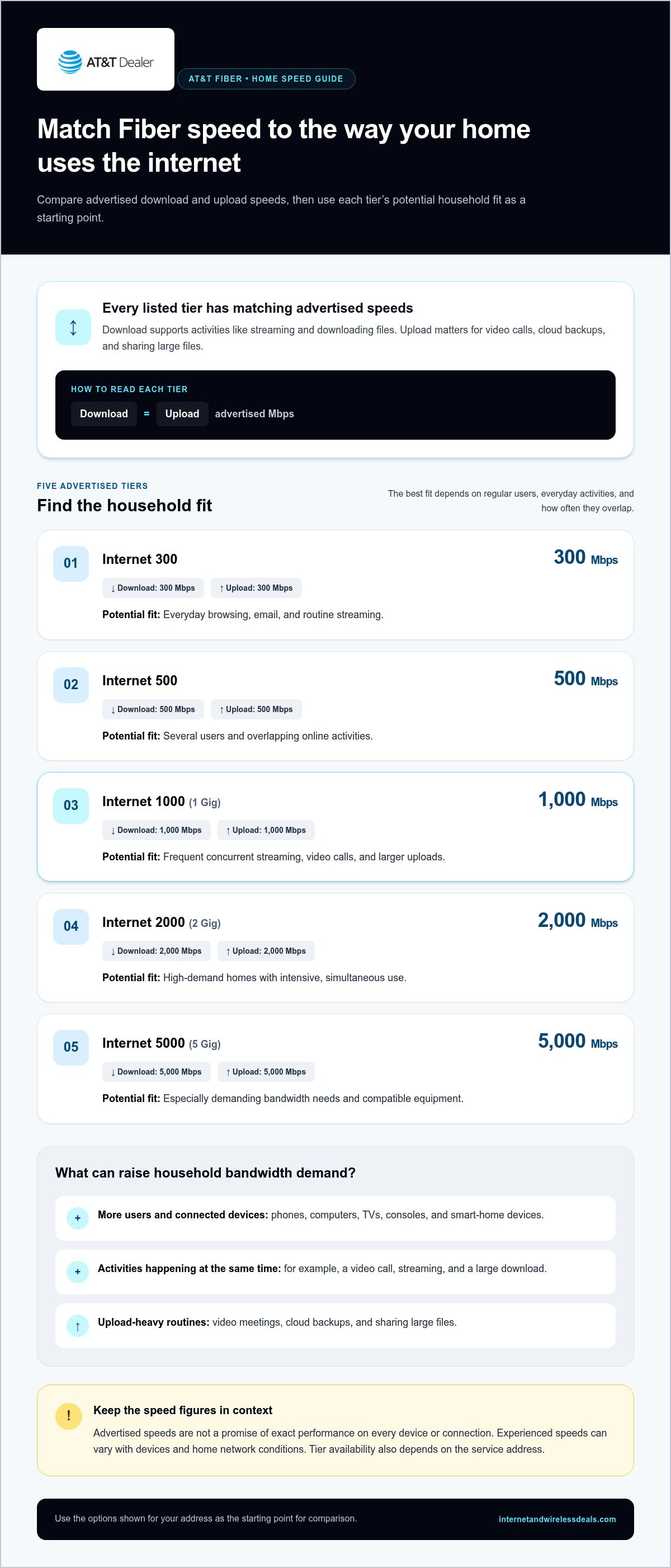
Fiber speed tiers describe how quickly data can travel to and from your home. Download speed affects activities such as streaming, loading websites, and downloading files. Upload speed matters when you send files, back up photos to the cloud, or share video during a meeting. AT&T Fiber tiers offer matching advertised download and upload speeds, though the speed you experience can vary.
Use this table as a starting point, then compare the options shown for your address. Advertised speed is not a promise of exact performance on every device or over every connection.
| AT&T Fiber tier | Advertised download speed | Advertised upload speed | Potential household fit |
|---|---|---|---|
| Internet 300 | 300 Mbps | 300 Mbps | Everyday browsing, email, and routine streaming |
| Internet 500 | 500 Mbps | 500 Mbps | Households with several users and overlapping online activities |
| Internet 1000 (1 Gig) | 1,000 Mbps | 1,000 Mbps | Frequent concurrent streaming, video calls, and larger uploads |
| Internet 2000 (2 Gig) | 2,000 Mbps | 2,000 Mbps | High-demand homes with intensive, simultaneous use |
| Internet 5000 (5 Gig) | 5,000 Mbps | 5,000 Mbps | Homes with especially demanding bandwidth needs and compatible equipment |
These are advertised plan speeds, not fixed requirements for every household. Specific tiers depend on the service address, and devices and home network conditions can affect experienced speeds. For more context on how fiber speed works, explore this AT&T Fiber speed guide.
Which internet activities need more bandwidth?
Email, browsing, and occasional streaming are usually less demanding than several activities happening at once. For example, one person might be on a video call while another streams a show and someone else downloads a large file. More simultaneous users and activities can increase demand. Upload capacity is also relevant for video meetings, cloud backups, and sharing large files.
Does every household need the fastest available plan?
Not automatically. A higher headline speed may help with heavy, simultaneous use, but it isn’t the best-value choice for every home. Consider the number of regular users, their usual activities, and how often those activities overlap. For broader consumer context, see Forbes’ Best Internet Providers Of 2026. To compare AT&T Fiber options for your address, review available AT&T Fiber plans.
How to compare AT&T Fiber pricing beyond the advertised offer
An advertised offer is only one part of the cost picture. Compare it with the recurring service charge and any additional charges disclosed for your order. A promotion may apply for a stated period or only to customers who meet specific eligibility conditions. Don’t assume the advertised monthly amount will apply indefinitely.
For a focused look at promotional offers, see this AT&T Fiber deals guide. Offers and enrollment details can change, so use the terms shown for your service address when reviewing a plan. A broader third-party perspective is available in CNET's review of AT&T internet plans.
Which pricing details should you review before signing up?
Read the offer details alongside the plan’s recurring service charge. Check the promotion’s duration, what happens after it ends, and whether eligibility depends on factors such as new-customer status or billing choices. Then review the order summary for disclosed taxes, fees, equipment terms, and installation details.
- Offer: Note its duration, conditions, and eligibility requirements.
- Ongoing charge: Look for the recurring amount and any stated rate after a promotional period.
- Equipment and setup: Review whether a Wi-Fi gateway is included and what installation terms apply to the order.
- Other charges: Check the final summary for applicable taxes or fees before enrolling.
Terms can vary by offer. Review the order summary for the details that apply to your address and enrollment rather than assuming that every promotion, equipment detail, or fee treatment is the same.
How to compare value without chasing a temporary headline
Start with the speed tier that matches your household’s activities, then compare the offer and ongoing terms. For a fair comparison, use the same service address and billing assumptions for each option. If an offer requires a particular eligibility condition, include that when judging its value. A lower introductory charge may look attractive, but the recurring charge afterward matters too.
Useful rule: “A strong offer matters, but the recurring terms determine whether the plan remains a good fit after the promotion ends.”
That’s the practical way to evaluate AT&T fiber plans and pricing: compare the complete terms, not just the headline. Save the details shown for your address so you can review the offer period, ongoing charge, and disclosed extras before signing up.
Choosing the right AT&T Fiber plan
The right plan starts with your household’s actual needs, not the biggest speed tier on the screen. Use this decision path to move from eligibility to a confident choice:
- Check the exact service address. Review which AT&T Fiber options are available there.
- Map your household’s use. Consider how many people are online at once and whether work calls, streaming, gaming, or large uploads are regular priorities.
- Compare the available tiers. Focus on the speed needed for everyday activities rather than paying for capacity you don’t expect to use.
- Review the current offer terms. Check eligibility, any promotional period, the recurring charge, and other details disclosed for your order.
- Choose the best-fit option. Balance your household’s needs with the complete terms before moving forward.
A practical plan-selection checklist
Keep the comparison grounded. Use the same service address for each review, estimate how many users are online at once, and prioritize the activities that matter most, including upload-heavy tasks. Then compare the current offer and ongoing terms for the tiers displayed at that address. This makes AT&T fiber plans and pricing easier to evaluate as a household decision, not just a speed contest.
Illustrative example: A household with regular video meetings, evening streaming, and occasional large uploads can compare tiers by considering how often those activities overlap. This is a way to frame the decision, not a promise of specific performance or a recommendation that one tier suits every similar household.
When should you consider a different speed tier?
Revisit your selection if several high-bandwidth activities routinely happen at once and the connection feels strained. But the plan tier isn’t the only factor. Wi-Fi equipment placement, signal strength, and the home’s layout can also affect the experience in different rooms. A plan change may not resolve every connection issue, so consider where and when problems occur before deciding.
Choose for your current routine while allowing for household changes you can reasonably anticipate. An unused speed upgrade may add little practical value. If frequent simultaneous use is straining your connection, compare a higher tier if it’s available at your address.
Ready to compare your household’s needs with available plans? Review AT&T Fiber options for your address.
How to sign up for AT&T Fiber
Ready to move from comparing plans to enrollment? Make one final pass through the address, selected tier, offer terms, and billing details. Options and enrollment information can change over time, so use the details shown during sign-up rather than relying on an earlier search or saved comparison.
What to review on the final offer screen
Before submitting an order, make sure the offer matches the choice you researched. Check each detail carefully:
- Service address: Confirm the full address, including any unit or apartment information. Eligibility and plan selections are location-specific.
- Selected plan: Verify the tier and advertised speeds you intend to order.
- Offer terms: Read the full terms, including any stated promotional period, eligibility requirements, and what happens when the offer ends.
- Billing details: Review the recurring charge, required billing preferences, and any disclosed taxes or additional charges.
- Order record: Save the order summary and confirmation so you can refer to the terms presented at enrollment.
Pause before submitting. If the address, plan, or offer details don’t match what you expected, revisit the options and review the current terms. This final check helps you decide based on the actual offer presented, not only an earlier headline or estimate.
Complete your AT&T Fiber plan search
Use the availability tool to view AT&T Fiber options for your exact service address, then follow the displayed enrollment steps for the plan that fits your household. Since availability, offers, and enrollment details may change, review the information shown when you sign up. Keep a copy of the final summary for your records.
Internet and Wireless Deals is an independent authorized AT&T retailer and third-party marketing partner. This website is not AT&T’s official site. It helps customers review AT&T Fiber options, check address-specific availability, and pursue sign-ups.
Start with the options for your address: check AT&T Fiber options. Reviewing the details on screen puts your AT&T fiber plans and pricing decision on a clear footing before enrollment.
Make Your Fiber Choice With Confidence
Start with the options available at your exact address, then narrow them to the speed your household uses and the offer terms that shape the ongoing bill. Compare the full details, not just the advertised promotion. That’s the clearest way to assess AT&T fiber plans and pricing and choose a plan that fits your everyday needs.
Internet and Wireless Deals is an independent authorized AT&T retailer, not AT&T’s official website. Use its availability and sign-up journey to review address-specific Fiber options and move forward with the details in view.
Check AT&T Fiber options for your address and compare the plans that fit your home. A careful review helps you make an informed choice.
Frequently Asked Questions
How much do AT&T Fiber plans cost in 2026?
AT&T Fiber pricing depends on the plan available at your address and the offer terms shown when you shop. Promotional rates may have eligibility requirements or apply for a limited period, so don’t treat an advertised amount as the ongoing monthly charge. Review the recurring service charge, offer duration, billing conditions, and any disclosed fees in the current order details before choosing.
What AT&T Fiber plan speed do I need?
Choose a speed tier based on how your household uses the internet. Routine browsing and email may call for less capacity than overlapping video calls, streaming, gaming, and large uploads. Count regular users and consider how often they’re online at once. The best fit isn’t automatically the fastest tier; compare your usage with the options available at your address.
Is AT&T Fiber available at my address?
Availability is determined by service address, so a general impression of coverage can’t confirm eligibility for a specific home. Enter the complete address in the availability tool, including a unit number if applicable, to see the options shown there. Nearby addresses may return different internet technologies or plan selections. Review the address-specific results when you’re ready to enroll, since availability can change.
Does AT&T Fiber pricing change after a promotional period?
It can. Some offers apply for a stated promotional period, and the recurring charge afterward may differ. Check the offer terms for how long the promotion lasts, any eligibility requirements, and the ongoing rate stated for the plan. Also review billing conditions and other disclosed charges. The current offer details for your address show what applies to your order.
Are AT&T Fiber plans unlimited?
Yes. AT&T Fiber plans include unlimited data, so customers don’t have a monthly data allowance to manage under the plan terms described here. That’s separate from the speed tier, which affects how quickly data can move to and from your home. Compare available speeds with your household’s online activities, and review the current offer details for your service address before signing up.
Can I get AT&T Fiber without an annual contract?
Yes. AT&T Fiber plans don’t require an annual contract. Still, review the full enrollment terms before placing an order, including the selected plan, promotional offer period, eligibility conditions, and any disclosed charges. Contract terms and promotional pricing are different details, so check both in the current offer summary. Save the order information and confirmation for reference after enrollment.
Are AT&T U-verse packages the same as AT&T Fiber plans?
No. AT&T Fiber plans refer to fiber internet service and its available speed tiers. “U-verse” has been used for other AT&T services and packages, so the name alone doesn’t identify a Fiber plan or its current terms. If you’re comparing an older account or offer with a current Fiber option, check the exact service, plan details, and address-specific availability shown for enrollment.


